
By Seleoe Nonyane
Water users will from today pay more after the Lesotho Electricity and Water Authority (LEWA) board this week approved the Water and Sewerage Authority’s (WASCO) application to increase tariffs.
This after LEWA’s board had met to deliberate on WASCO’s application. After due consideration and accordance with the tariff review process, the board made a decision that the company’s revenue requirement will be M268.90 million consisting of M232.29 million and M36.61 million for water and sewerage services.
LEWA is a statutory body established to regulate the Lesotho Electricity Supply Industry and Urban Water and Sewerage Services.
Among other things, LEWA is empowered to regulate prices charged to consumers of electricity and urban water and sewerage services.
The authority indicated that in order to meet the revenue requirements (RR) of M232.29 million, water volumetric tariffs and standing charges will be increased by 4.9460 percent and 1.2959 percent.
In order to meet the revenue requirement of M36.61 million for the sewerage services, the volumetric tariff will be hiked by 1.57 percent.
Water connection fees will be adjusted upwards by eight percent for the financial year 2023/24 pending a comprehensive study.
Other charges remain the same.
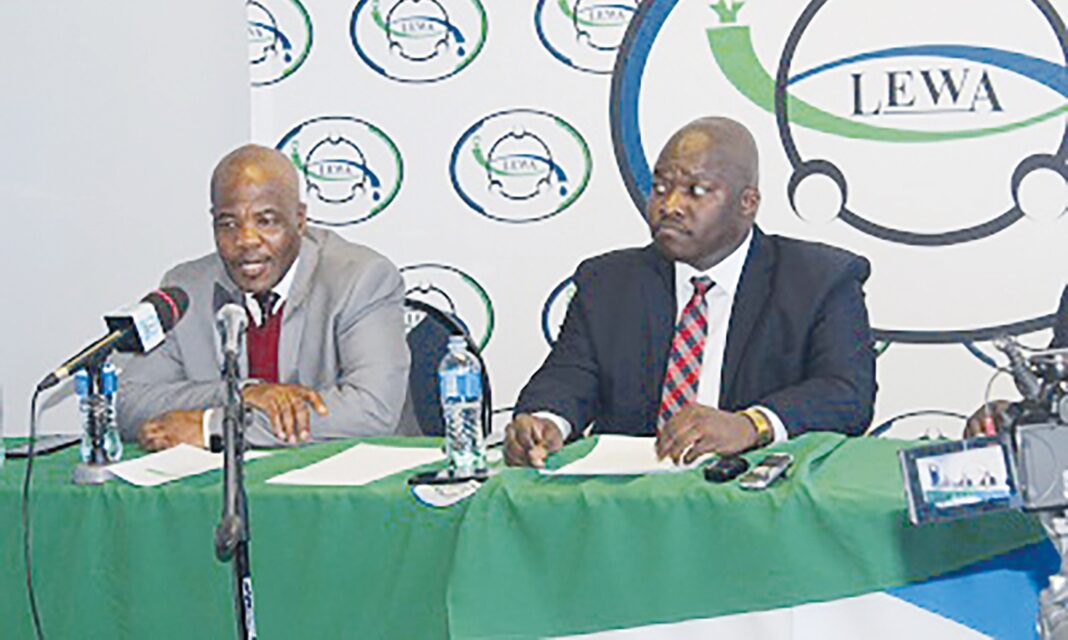
The chief executive officer of LEWA, Monti Ntlopo, revealed that the authority received a tariff application from WASCO on June 19 2023 requesting for an RR of M298.835 million, comprising M251.452 million and M47.410 million for water and sewerage.
Ntlopo announced on Monday this week that WASCO had also proposed upward adjustment in water and sewerage tariffs for the financial year 2023/24 – a 14.8 percent increase in domestic and non-domestic volumetric charges, a 4.7 percent increase in domestic and non-standing charges and 31.5 percent increase in sewerage tariffs.
Besides the request for upward adjustment in water and sewerage tariffs, WASCO had also requested to be allowed a full 100 percent recovery on new water connections from the start of the financial year 2023/24, he noted.
“In addition, WASCO requested to be allowed automatic annual adjustment on the prices of input materials by officials, inflation value post financial year 2023/24, and proposed to submit its updated connection cost card to the Authority on an annual basis for consideration and approval,” Ntlopo said.
He added that in reviewing WASCO’s application, the authority considered several factors including low economic performance and high inflation resulting from, among other things, the ongoing Russia-Ukraine war and the need to strike a balance between the sustainability of the company and affordability of water and sewerage services by the customers.
He indicated that the authority also considered stakeholders’ inputs and comments on the company’s application.
Furthermore, some observations made by the authority include WASCO requests for increase in tariffs in order to improve its revenue and cash flows yet its services have been deteriorating over the years.
“(WASCO) deviates from the set of 46.5 percent with respect to Non-Revenue Water.
“(It also) … performs below the set standard in affecting new connections and resolving customer complaints,” Ntlopo noted.
For her part, WASCO’s monitoring and evaluation officer (strategic section) Moipone Lehloara said they accept the LEWA’s decision.
She added that the company is determined to ensure that it offers every Mosotho quality services at all times.
WASCO would go back and look at the LEWA’s tariff determination and engage LEWA where the need arises.
Lehloara also noted that WASCO is committed to achieving all the recommendations set by the authority.
WASCO submitted an application for tariff adjustments in June this year and LEWA responded by calling on stakeholders and the general public to submit their comments and inputs on the proposed tariff adjustment application. Public hearing sessions were held from July 18 to 27.