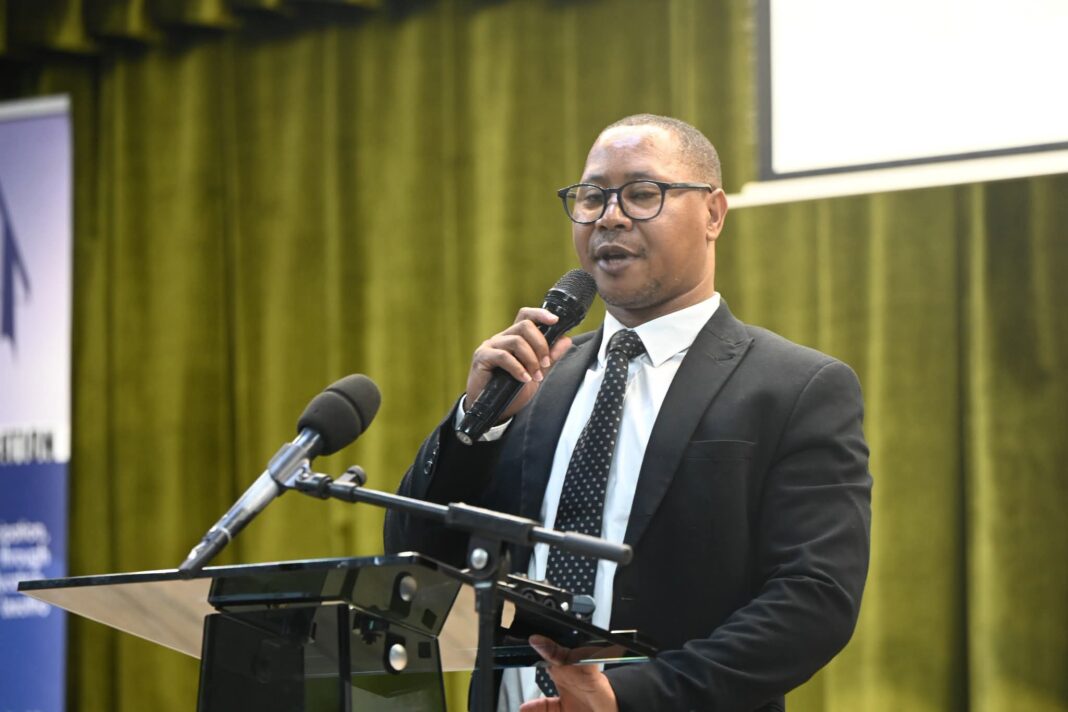

Failure by higher learning institutions to account for public resources undermines institutional governance and public confidence in the sector, Minister of Education and Training, Professor Ntoi Rapapa has warned.
He said it was imperative for such institutions to comply with statutory financial reporting and auditing requirements.
They should also ensure that their financial statements are audited and submitted in accordance with the laws governing higher education, he noted, citing that financial transparency and accountability were essential to responsible institutional management.
The warning comes amid revelations by the Council on Higher Education (CHE) that some institutions have either failed to conduct financial audits or have not reported audited accounts, while others have received qualified audit opinions.
Speaking at the recent Higher Education Symposium 2026, Prof Rapapa said institutions needed to comply with the Public Financial Management and Accountability Act (PFMA), 2011, and other applicable laws, as well as regulatory requirements set by the CHE.
The obligation to conduct financial audits is expressly provided for under the Higher Education Act, 2004, which establishes financial reporting requirements for both public and private higher education institutions.
Section 35 requires public higher education institutions to maintain proper accounting records and submit duly audited financial statements, including statements of income and expenditure, balance sheets and cash-flow statements.
Section 39 extends the requirement to private higher education institutions, obliging them to maintain proper accounting records, prepare financial statements and undergo annual audits. It further requires certified auditors’ reports to be submitted to the Registrar, with failure to comply constituting an offence.
The PFMA Act, 2011, also provides for financial reporting and auditing requirements for government spending units and public enterprises falling within its scope.
Prof Rapapa called for stronger resource mobilisation, improved financial management and meaningful partnerships with development partners.
He cautioned, however, that institutions should not respond to financial pressures by increasing student fees without considering the implications for access, particularly for students who finance their own education.
“Financial sustainability should not come at the expense of educational quality or exclude students who cannot afford higher fees,” he said.
Presenting a review of the higher education sector, Director of Quality Assurance at CHE, Nthabiseng Mobe, said the regulator had identified gaps in compliance with financial reporting requirements.
“What we observed from our audits is that we still have some institutions that do not audit or that did not report having audited their finances in the years that we were collecting data. And in some instances, although the institutions had conducted audits, the audits were qualified,” she pointed out.
Mobe explained that audited financial statements enable government, regulators and other stakeholders to assess how institutional resources are managed and whether financial operations comply with established requirements. They also provide an important basis for assessing institutional financial health and sustainability.
Mobe also indicated that the sector remained heavily dependent on government financing, with approximately 80 percent of students sponsored through the National Manpower Development Secretariat (NMDS).
This reliance, combined with direct government subventions to some institutions, exposed the sector to financial vulnerability and limited its ability to diversify income sources.
“Our data has shown us that 80 percent of our students are sponsored by the National Manpower Development Secretariat,” she said.
Mobe warned that institutions were becoming increasingly dependent on government rather than developing alternative sources of revenue.
She added that the gaps between institutions’ ideal budgets and the actual resources available to them remained substantial, raising questions about their capacity to expand access, diversify programmes and meet their institutional objectives.
The financial concerns formed part of broader discussions at the two-day symposium, held under the theme, ‘Strengthening Governance, Sustainability, Accountability and Quality in Higher Education’.
CHE Chief Executive Officer, Dr Moeketsi Letete, said the symposium came at a critical time for Lesotho’s higher education sector, particularly as technological developments, artificial intelligence and changing labour market demands reshape the global education landscape.
He announced that Lesotho had recently ratified UNESCO and global conventions on the recognition of qualifications, a development expected to strengthen the country’s participation in international cooperation and facilitate the recognition and mobility of qualifications across borders.
“We are now part of the global brothers and sisters who want to promote mobility and recognition of qualifications across the globe,” Dr Letete noted.
However, he stressed that international recognition would also require domestic institutions to strengthen their systems and ensure that qualifications awarded in Lesotho met the required standards.
Institutions were increasingly expected to demonstrate not only compliance with regulatory requirements but also continuous improvement in the quality and relevance of their programmes.
The CHE Strategic Plan 2025-2030 places emphasis on modernising governance, strengthening quality assurance and aligning higher education provision with labour market needs.
Dr Letete challenged the sector to move beyond measuring its success through the number of qualifications awarded and instead assess whether graduates possessed the knowledge, skills and competencies required to contribute meaningfully to national development.
“The fundamental question that we have is not whether higher education is important. But what we need to be focusing on is whether the higher education that we have in this country is actually delivering the outcomes that are needed to change the society,” he said.
He also questioned the country’s growing reliance on foreign institutions to educate Basotho students, arguing that greater attention should be given to strengthening local universities and colleges.
While acknowledging the importance of international scholarships, particularly in fields where critical skills are not available locally, he stated that the country needed to examine whether its investment in overseas education was balanced with investment in domestic institutions.
He argued that continued sponsorship of students abroad, without comparable investment in local institutional capacity, could undermine the long-term development and competitiveness of Lesotho’s own higher education system.
Lerotholi Polytechnic Rector, Professor Tlali Sepiriti, said higher education financing should not be treated simply as an expenditure item in the national budget, but as a strategic investment in human capital, economic productivity, institutional capacity and long-term development.
Prof Sepiriti said Lesotho has historically relied heavily on government support, which comes mainly in two ways — subvention to institutions and student sponsorship — alongside limited third-stream income generated by institutions themselves.
He argued that government must therefore address two related but distinct questions: how institutions themselves should be financed to ensure financial sustainability and quality education, and how students should be financed so that access is not determined by ability to pay.
“Institutional financing covers teaching, research, infrastructure and administration, while student financing must cover tuition, accommodation, food, learning materials, transport and other expenses,” he said.
Prof Sepiriti cautioned that heavy dependence on government finance exposes institutions to fluctuations in national budget allocations and competing government priorities, including healthcare, basic education, infrastructure, social protection and debt service.