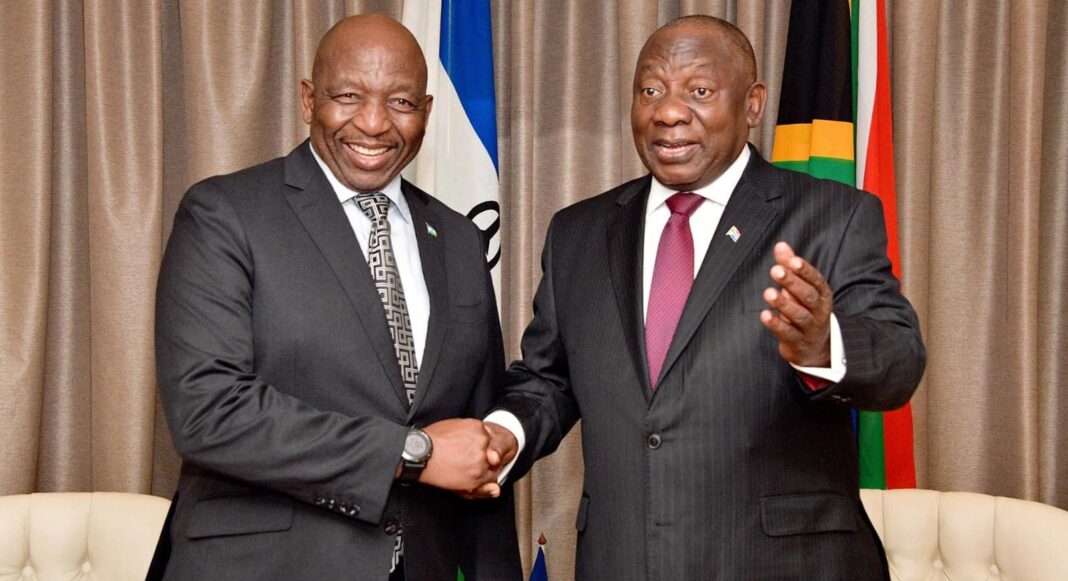

Maxwell Sechaba Makhasane is a conciliator and arbitrator by profession. He has vast experience in practicing as a human resource manager after having worked for several companies. In this interview with theReporter, he unpacks the role of a conciliator and arbitrator and explains decries the backlog of case at the labour court.
Please tell us briefly about yourself and your educational qualifications.
I did my primary education in Lesotho from 1966 to 1970. I left the country when the government declared a state of emergency due to political instability at that time. My family fled the country to Natal in South Africa where my mother was born. I joined the mining industry in 1977 after leaving school and became part of the National Union of Mineworkers (NUM). I was expelled from work as a result of my participation in a national strike in 1987. I was denied entry into South Africa for five years and this saw me joining the labour movement in Lesotho. In 2001 went to further my studies at the University of Namibia to pursue a post-graduate diploma in law in conciliation and arbitration. After my graduation I joined the textile industry as a human resource manager. I was appointed as a part-time conciliator at the Directorate of Dispute Prevention and Resolution (DDPR) while also serving in both the labour and labour appeal courts.
How did you end up being a conciliator and arbitrator?
As a result of the strike that affected the Lesotho Highlands Water Project and the textile industry, the International Labour Organisation and the Kingdom of Lesotho agreed to introduce a new weapon which would assist both employers and workers in resolving their disputes speedily and without any heavy expenses, hence the formation of the DDPR where I was engaged as a part-time conciliator for about three months. That meant I could not handle any matter in my capacity as a qualified arbitrator. I only became a frequent and regular practitioner at the DDPR representing employers in their disputes and also as a labour consultant. I do not know how many cases I have attended at the DDPR except that since qualifying as an arbitrator I have only lost three cases.
What does being in this profession entail in terms of duties, based on labour law?
As a holder of a Post-Graduate Diploma in Law (conciliation and arbitration) it is of paramount importance to understand the dynamics of the profession, as well as the role and the significance of justice from a broader perspective. The decisions that one makes as both human resource manager and arbitrator must also be based on facts and absolute evidence taking into account the provisions of the law and tried law judgments. As a human resource practitioner, one should ensure that the decisions taken at the workplace will more often than not, be upheld by the DDPR should the need arise that such decisions are challenged. Workplace decisions overturned by the DDPR can impact negatively on employers. It is advisable that even at arbitrations level the award one makes stands its ground even if challenged at the labour court. Also, awards at the DDPR need not be ambiguous and should be in simple language that both the applicants and the respondents fully understand. The awards should be given within a reasonable time while the facts are still fresh in the mind of the arbitrator. One should also try to manage body language because it can be deemed to be partial.
What are the biggest challenges that you have encountered in your field and how did you manage to deal with them?
I don’t wish to dwell much on the challenges I encountered or facing arbitrators. I have never delivered any judgement in my capacity as an arbitrator. However, the most challenging is to be asked to recuse yourself from a case simply because the other party (especially employer) feels you might be biased in the judgment also as a former trade unionist. One should highlight to both parties that your role is not necessarily to participate in the matter and instead that you are only there to assist the parties to reach an agreement which is real to all concerned. Parties should feel they own the agreement or decision reached.
How do you manage to arrive at a decision considered to be fair to all parties?
This a tricky situation especially in conciliatory process where parties do not exactly understand the role of a conciliator/arbitrator. For a decision to be fair, it has to be balanced with evidence and facts presented taking into account the position of the law in the arbitration process. As far as conciliation is concerned, it is imperative to acknowledge that in most cases employers are more equipped in handling disputes, particularly where the worker is nor represented by a trade union. Employers, though not all of them, sometimes have the unacceptable attitude of ridiculing, undermining and humiliating an employee at the negotiating table. This is a disturbing trend that has to be dealt with severely by the conciliator/arbitrator in order to allow the employee to feel comfortable and protected during proceedings. According to ILO instruments, it is perceived that an employee is always vulnerable and as such, every effort must be made to accommodate their ignorance without necessarily being biased. Once established, this will help the employee to have confidence in the system. It is imperative to inform parties that during the arbitration proceedings, even before the award is issued, they are at liberty to challenge the outcome if they are not happy with it. They must also be informed that the Labour Court is the appropriate body to refer the matter to. Both parties should be given ample time to state their case in their own way in both statements and closing remarks. It is also beneficial to show in the award that all admissible evidence has been captured in order to satisfy parties that indeed as conciliator/arbitrator one applied their mind to the matter before them.
There are complaints from some quarters that some cases take long before decisions are reached. What are the causes?
It is a pre-requisite in terms of the rules of the DDPR that cases are finalised speedily and awards issued within 30 days. Unfortunately, this is not always the case due to some reasons. Since practicing lawyers have been admitted into representing disputants at the DDPR, cases are taking too long to be resolved and the backlog is too much to comprehend. These lawyers always postpone cases in order to attend what they call urgent cases in other courts as if DDPR matters are not urgent. The main reason is because clients are charged per attendance instead of upon completion of the case. It means in a day a lawyer is paid per attendance before the DDPR for a postponement which sometimes takes less than 10 minutes and also an allowance for appearing before any court on the same day. This trend appears to be gaining momentum; it is so sinister that it plays a major role in the intensified backlog cases at the DDPR.
Again, trade union officials are not skilled enough to make healthy decisions on behalf of their members lest they are loggerheads with their superiors, hence they always ask for unnecessary postponements in order to allow them to consult further with their offices.
What do you think of labour law systems in Lesotho?
The establishment of the DDPR has played an important role and integral part in minimising the rate of spontaneous wild-cat strikes and enhancing harmonious working relations at the workplace. This means even non-unionised workers have a right to appear before the DDPR whenever they feel like their rights are being trampled upon or abused by stiff necked employers.
What is the role of the trade union movements within conciliation and arbitration practices?
Truly speaking, I have reservations when it comes to the capacity of trade unions in representing their members effectively in labour matters. The level of education of some union officials is so shallow that the law is unclear to them to deal with challenges workers encounter at the workplace. It is important that the union officials are capacitated and equipped with necessary skills.