
‘Mantšali Phakoana
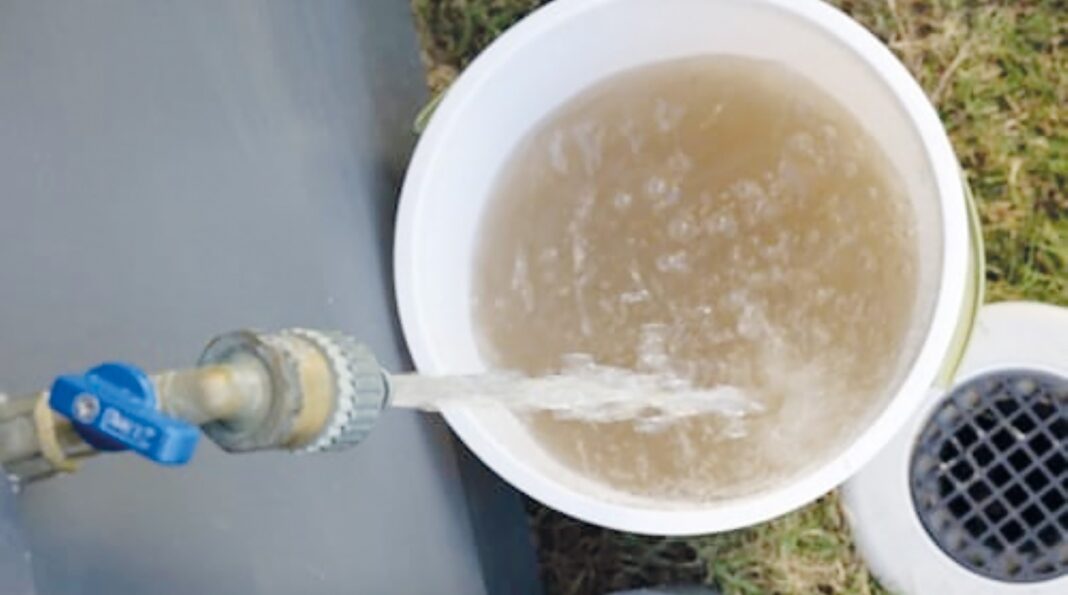
Some Maseru residents say they are at risk of contracting diseases as they are forced to use tap water contaminated with sewage and infested with worms for almost a month now.
Villagers from Ha-Foso, Sekamaneng, Koalabata, Ha-Tšosane, Tšenola and Ha-Tšiu told theReporter in separate interviews this week that contaminated water has been coming out of their taps since the beginning of the festive season.
The taps are supplied by the city’s water reservoir based at Sehlabeng sa Thuoathe.
‘Mamahlapane Letsatsi, a resident of Koalabata yesterday said she discovered unusual brown water with a bad smell coming out of her tap two days before Christmas.
She noted that three of her neighbours sharing the same pipe also encountered a similar problem. Two other neighbours also discovered small worms in the water.
“The moment I discovered a brown colour with a sewage-like smell in my water, I called my neigbours to witness the situation and soon after they left my yard, they checked their taps only to find a similar problem.
“We all panicked and started questioning other neighbours about the issue. Two had a worse situation of small worms in their water from the taps,” Letsatsi said.
She added that they immediately informed WASCO (Water and Sewage Company) through their toll-free number and its employees only showed up on December 27 to examine the situation.
Since then, the villagers have not used water from their own taps but are forced to buy drinking water or fetch from households that were not affected.
Letsatsi added that having to buy water for drinking has placed a serious financial burden on them.
For his part, Lefa Matamane of Ha Tšosane said his tenants informed him about the muddy water on December 17 last year.
The problem had started the previous week, he noted.
“I reported the matter to WASCO through their toll-free and WhatsApp numbers the same day I got complaints from tenants, but to my surprise the company has never came to see what is going on.
“The most frustrating part for me is that the tenants are looking to me to solve the matter yet there is nothing I can do, except to pressurise WASCO to act. Honestly, the matter is beyond me.
“Since the problem started, I have been bothering the company because I suspect that the water is not safe for human consumption. We really need help,” Matamane said.
His sentiments were echoed by one of his tenants, Likeleli Maichu, who indicated that water coming out of their taps had small particles looking like pine tree leaves.
Maichu said sometimes the water comes out brown and not drinkable even when boiled.
“When we discover small pieces similar to pine tree leaves in the water, we boil it before using it for both drinking and cooking but the fact that we are consuming dirty water irks us.
“We are doing that because we need water daily and do not have any other alternative. We also do not know if it is safe for our health. Some people tie folded cloth to the tap or buckets to sift out the particles but finer particles of mud and stink cannot be removed this way.
“WASCO must do something about this situation before people die or before there is an outbreak of diseases,” Maichu warned.
WASCO said it was aware of complaints from the aforementioned villages, adding that investigations were under way to establish the cause of the discoloured water.
In a statement released on Wednesday this week, WASCO indicated that it started its investigations on December 27 last year and they were still continuing.
It said the probe revealed that only a few households sharing the same pipeline had experienced the contaminated water problem. However, the company did not state the cause of this.
The utility was quick to allay public fears, saying the water was harmless.
The disinfectant applied to the water is enough to kill any form of germs that could endanger human health, it indicated.
WASCO further pleaded with consumers to report similar problems via its toll-free number 80022011, WhatsApp number 57000365 and investigations supervisor at 68009933/22262008.
In its 2022-23 annual report published on December 6, 2023, the Lesotho Electricity and Water Authority (LEWA) revealed that some of WASCO’s Wastewater Treatment Plants (WWTPs) had deteriorated.
The authority added that there was sludge build up and vegetation ingress at the WWTPs, which compromised the quality of treated effluent.
LEWA conducted the inspections and audits as part of its efforts to regulate urban water and sewage services in the interests of all stakeholders and support their growing and ever-changing need.
The inspections on all the 16 WASCO centres were aimed at checking compliance with safety, technical and customer care standards as set by the authority.
The investigations also showed that some of WASCO’s Water Treatment Plants (WTPs) units were non-functional, thus compromising produced water quality.
Some reservoirs were leaking, resulting in increased non-revenue water. Also, chemicals were stored in direct sunlight thereby degrading their chemical integrity.