
King Letsie III has many blissful wishes for his people.
He envisions a Lesotho where children are well-nourished by 2030 and beyond.
He looks forward to a future where Basotho youth are entrepreneurs rather than job seekers, women venture into agro-processing, farmers are exporters of note.
His Majesty also envisages rural communities across the country becoming centres of innovation and playing a crucial role in national development.
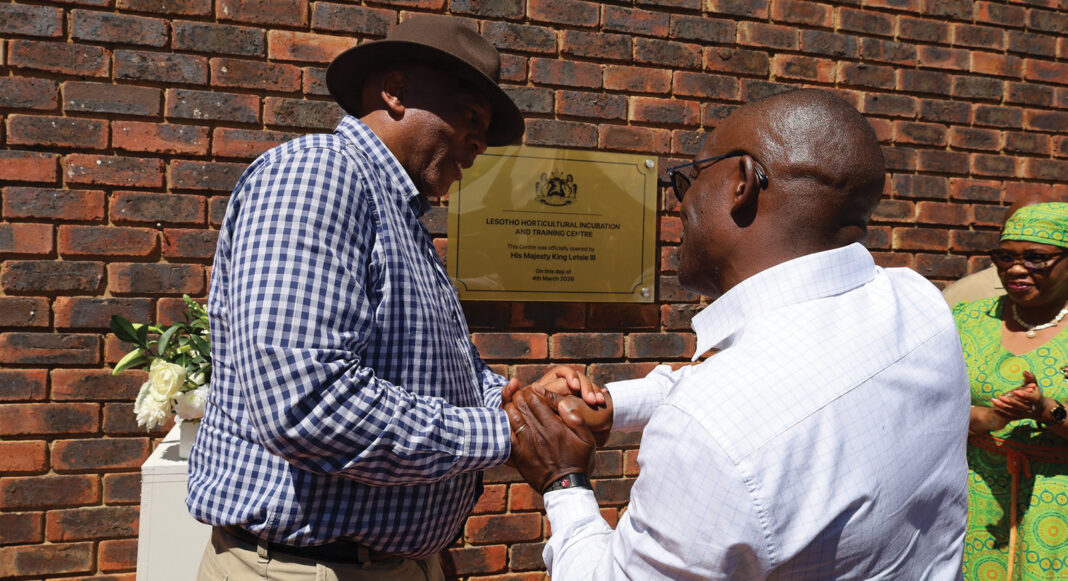
A remarkable farmer of note himself, King Letsie III took the nation into his psyche during the official launch of the Lesotho Horticultural Incubation and Training Centre at Mahobong in Leribe this week.
The centre is a key Competitiveness and Financial Inclusion (CAFI) project supported by the World Bank, designed to boost commercial farming, strengthen agricultural value chains, and promote climate-smart agriculture.
It will provide farmers with hands-on training, technical support, incubation services, and improved market access to increase local production and expand export opportunities.
His Majesty is the African Union (AU) Nutrition Champion and Food and Agriculture Organisation (FAO) Special Goodwill Ambassador for Nutrition.
He said no industry can thrive without requisite skills, knowledge and institutional support.
“This centre serves as an engine of entrepreneurship through business incubation and training services,” he noted.
To date, 190 farmers have completed pre-incubation training and 11 farms have entered for this mentoring. These include three established demonstration farms and two commercial vegetable farms.
This success is a result of deliberate investment in skills development, sound business planning, and improved access to market.
“Building on this momentum, we anticipate the establishment of at least five additional commercial food farms within the year,” King Letsie III stated.
He noted that through this horticulture initiative, Lesotho is demonstrating leadership by aligning national implementation with AU targets on food security, value addition, youth and women.
UNDP resident representative to Lesotho, Jacqueline Olweya, reaffirmed her organization’s commitment to supporting Lesotho’s agricultural transformation and rural development priorities.
Olweya pledged continued partnership with the government, IBSA Fund, development partners, and the private sector to expand market access, financing opportunities, and climate‐smart innovation.
“UNDP will position this centre as a national asset that will continue shaping skills, entrepreneurship, and opportunities, especially for youth and women,” she said.
On his part, the Minister of Trade, Industry and Business Development, Mokhethi Shelile, said the centre is an important milestone in Lesotho’s journey towards building a productive, export-driven and resilient economy.
Its launch, together with the pack house facility, marks a critical step toward advancing the horticulture sector as envisioned in the extended National Strategic Development Plan II.
Shelile indicated that horticulture holds a central place within national priorities, contributing to food security, employment creation, and private sector-led growth through the export of high-value produce.
“As a country, we are guided by the extended NSDP II which sets us on a path to transition from a consumer-based economy to one that is drive by production and exports. To support this transition and address long-standing structural constraints, my ministry developed the National Trade Strategy underpinning the National Trade Policy Framework.
“These strategic instruments guide our efforts toward a diversified and resilient economy, focusing on priority sectors where Lesotho has comparative and competitive advantage: horticulture, textiles and apparel, and light industries,” he pointed out.
Through these frameworks, the sectors aim to break through the limitations of their narrow export base and tap into new market opportunities.
“As such, the horticulture sector exemplifies this ambition,” Shelile said.
Speaking at the same occasion, the Principal Chief of Leribe, Joel Motŝoene, urged community leaders to work with different ministries to make the programme a success.
“Let us hold hands and work and not disappoint King Letsie III. Let this project not only be in Mahobong but expand to other areas as well,” he pleaded.
The Area Chief of Mahobong, Mosito Khethisa, said they were pleased with development initiatives taking place in the area and helping to create employment.
“We promise to protect the facilities so that they can serve their intended purposes,” he added.
Key project achievements to date
• Capacity building: – 190 farmers have completed pre‐incubation training, 80 farmers completed advanced horticultural training, nine were selected for full incubation, with seven new commercial orchards established.
• Production expansion – 76,000 deciduous fruit seedlings including other agricultural inputs worth US$98,000 were procured and planted across beneficiary orchards.
• Job creation – 170 jobs have been created through new orchards and commercialisation activities.
• Infrastructure support – Installation of a state-of-the-art sorting and packing line machine to strengthen post‐harvest value addition and market access, worth about US$200,000 (about M3 million). The machine uses advanced technology, fully automating the sorting and grading process through high‐precision image processing and smart sensor systems.
• Institutional strengthening – Establishment and registration of the Horticulture Association of Lesotho, providing a platform for farmer organisations, advocacy, and collective marketing.
The Horticulture Incubation Hub and Training Centre provides support for scaling commercial horticulture farming in Lesotho by building on lessons from the three pilot deciduous fruit farms.
The facility seeks to address gaps in the value chain as well as access to suitable land, infrastructure, extension services, skills, finance and markets while promoting climate-smart agricultural practices.
The facility is based at the former Mahobong Campus of the Institute of Extra Mural Studies (EIMS) in Leribe.
CAFI is a US$52.5 million project funded by the World Bank and the Lesotho government. The project is founded on three mutually reinforcing pillars: Enhancing Financial Inclusion and Resilience of MSMEs, Scaling Support for Entrepreneurship and MSMEs, and Project Management Support.