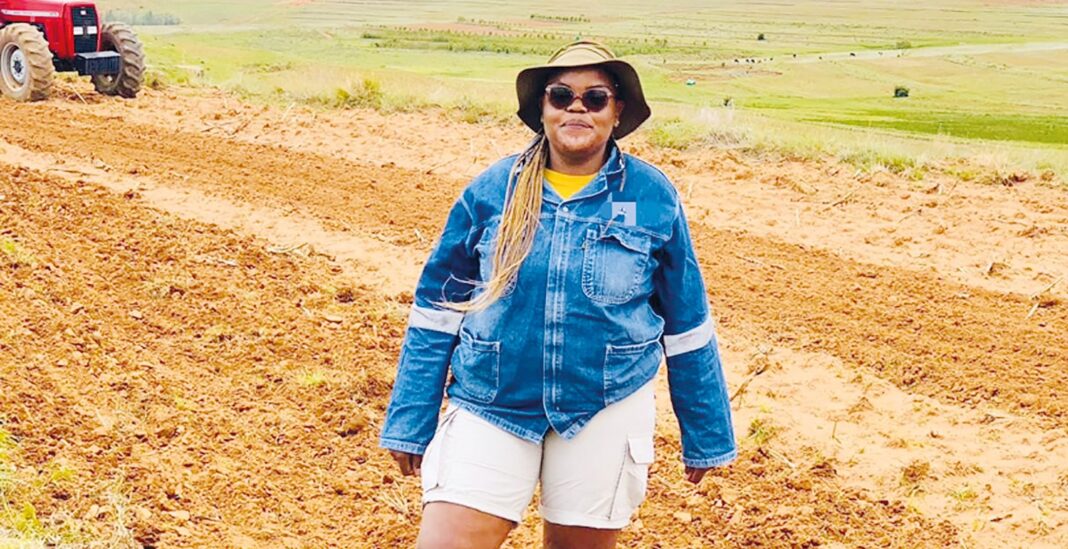

Cultural norms have many a times discouraged women from venturing into profitable forms of farming. In Lesotho for example, rearing sheep, goats and livestock is often considered “men’s work” and women are restricted to growing crops even though raising livestock can be a better opportunity to earn income and access to additional sources of nutrition like milk as well as wool and mohair.
Rethabile Kou (24), who is the managing director of Thabie’s Farm Enterprise, broke the stereotype by venturing into the male-dominated sheep rearing sector. In an interview with theReporter’s ‘Mantšali Phakoana, Kou takes us through her journey into farming.
Please tell us about yourself and your educational background.
I am Rethabile Sarah Kou, born and bred in Ha Thetsane. I’ve a Bachelor’s Degree in Mining Engineering. I am the founder and manager director of Thabie’s Farm Enterprise.
Who/what inspired you to go into sheep rearing?
My father who is into farming inspired my love for sheep rearing. When I was growing up, I used to watch him do his daily farming activities like feeding livestock and cleaning. Since he has always been my role model and friend, I became interested in the way he used to care for his livestock. I would help him wherever I could. That is where my motivation came from.
My father has always been my inspiration and mentor. He has always believed in me ever since my mother died when I was 10. I have learnt a lot from him. I’m always learning and hoping by the time he retires due to old age, he can always relay on me. Research and stories from internet also inspired me a lot.
Apart from that, I was also challenged by the high rate of unemployment in Lesotho. I wanted to do my own thing and employ other youth. Some of them are educated up to PhD level but there are no jobs. I promised myself that I was never going to let unemployment put my life on hold. Having a supportive parent like my father and other people surrounding me made it easy for me.
When and how did your journey into being a farm owner started?
My journey started with rearing piggery but here I do not want to lie, I failed dismally. I was rearing them from home. I believe I did not put enough effort. Nevertheless, I am thankful that the failure did not make people who believed in me such as my father think any less of me. He encouraged me to soldier on even in that situation. I’m who I am today because of the people surrounding me.
After failing at my first attempt, I did not give up. I had to find another way to build my empire. I went into rearing sheep in 2020 after I graduated. I started with 14 sheep which my father (Mr Tṧolo Kou) gifted me as a birthday present knowing my passion in sheep rearing and farming in general. Since then, I’ve never looked back and I am not intending to stop.
Why rearing sheep and not any other livestock?
Amid the rising unemployment in the country, sheep farming is gaining popularity among the youth. There’s a huge market for sheep. In our country it is easier to maintain sheep than livestock like cattle. Rearing sheep is a potentially profitable industry with many economic benefits.
A farmer just needs to efficiently produce high-quality lamb and wool that can be profitably marketed. They need to evaluate the resources they have. They will have to design a sheep production system that will use those resources most efficiently. It is also important to research about sheep rearing, the associated diseases and how to improve the sector further. Rearing sheep can also provide financial security.
Rearing sheep has been regarded in Lesotho mostly as men’s work. What is opinion on this?
It is true; livestock, wool and mohair farming are a male dominated industry. I wanted to break that chain. I wanted the youth, especially females, to see that they can also make a living out of farming.
In the past, toughness and strength were considered masculine traits and these were required for one to be a good wool and mohair farmer. I have always wanted to be different and run my own race. I believe in doing my own thing and I enjoy that spirit. What I do now (being into farming) gives me joy. From where I stand, I do not wish to be hired. I want to provide jobs not the other way round.
Being a female has made the journey easier for me because of the support and encouragement I get from people close to me and others who don’t even know me. People (especially men with experience in rearing livestock) who saw my work on social media also support me with the believe that I am a woman and I need more assistance. I find that very fascinating. I hope one day I’ll stand out because of sheep to say I did it for all women in the hope that some will walk in my footsteps to prove to the world that women are also capable.
What are the biggest challenges in sheep shearing?
Like any other business, the journey is not a smooth one; it has its ups and downs. However, I focus on the ups that is why giving up will and has never been an option when experiencing any hardships.
The biggest challenges in rearing sheep are theft and disease outbreaks. Rearing sheep is expensive – from raising and feeding to maintaining mohair. This helps to ensure quality animals. COVID-19 pandemic also contributed to a significant loss in the sector because it was not easy to maintain sheep with restricted movement.
Also, the pandemic came with frustrations that included increased sheep food prices. Luckily, I’ve always made a plan to produce homemade food for my sheep.
Is your focus solemnly on sheep rearing or you are planning to pursue other forms of farming?
My intention is to broadened my capabilities in farming. Sheep rearing is not the only farming method that have been proven profitable and in demand. It might be where I started but I am also into crop farming. I invested into ploughing maize and beans, which I successfully harvested in winter this year. I have realised that when you have sheep or any form of livestock, ploughing maize is also essential because the maize or its stick are animal feed.
Where do you see yourself in future?
My goal is to have 300 sheep by the time I’m 26 and from where I am standing it is possible. I also aim at expanding and venturing into other farm related projects too; like ploughing beans and sorghum. These sell well.
My aim is to become Lesotho’s biggest Merino farmer. I plan to sell sheep and auction rams to local farmers to keep them from buying expensive animals from South Africa.
What is your message to young women out who are hesitant to go into male-dominated ventures?
It is high time that women and young girls start believing in themselves. They should show the world that we too are capable of venturing into all forms of businesses including those known as ‘male dominated’.
While you do so; remain humble because that only can take you to places. Make each day count. Set your goals, work on them! It is all possible. Start with the little that you have, do not expect to start with bigger things. Most successful people started small.
I always say if you are really passionate about something, you will find a way to get it. If you are not, then you will find an excuse not to do it.