
By Matṧeliso Phulane
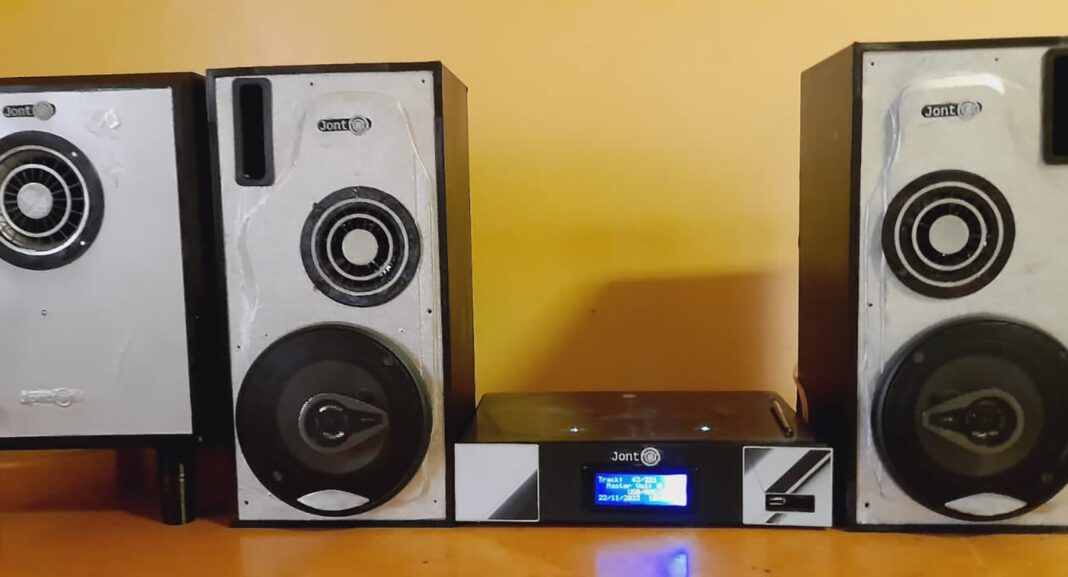
Lerotholi Polytechnic alumnus, Refiloe Jone, has made a revolutionary mini Hi-Fi system which he says is the first of its kind in the whole world.
High fidelity (often shortened to Hi-Fi) is the high-quality reproduction of sound which is popular with audiophiles and home audio enthusiasts.
This sound system is controlled by gesture and smartphones. Unlike normal Hi-Fis, it responds to gestures without physical contact.
Jone started developing his project in 2017 and he has now created three Hi-Fi sets that connect via Bluetooth.
The work is a result of Jone’s observation that traditional radios often suffer burnt components, which creates a mess. What makes his creation stand out is its ability to tackle these issues head-on.
“As a person who always fixes electronics devices, I have identified the same problem on amplifiers and Hi-Fi systems. Only two things get burnt – power supply or amplifier integrated circuit, because they generate a lot of heat.
“What sets this Hi-Fi apart is its exceptional features. The digital power supply detects and cuts electric transmission at the first sign of trouble. This prevents damage, the amplifiers follow suit. They stop electricity upon detecting faults. They reinstate it once the problem is resolved.
“You swipe to change songs. You make circular movements for volume control. You do the same to explore its four modes: FM radio, MP3 playback, auxiliary input, and Bluetooth connectivity,” Jone explained.
Thermal protection ensures the radio shuts off during overheating giving the Hi-Fi a chance to last a lifetime.
Notably, Jone’s design replaces physical buttons with sensors, preventing damage caused by constant pressing. Again, this thoughtful approach not only enhances durability, but it also sets the Hi-Fi apart from traditional models.
Jone’s enthusiasm in electronics started when he was a young boy. He noted that whenever he was bought toys, he would open them to see exactly what was inside.
Besides that, at high school level he used to attend science fairs to present his projects.
“When I was in Form D, I began to fall in love with electronics and knew already that there would be no other tertiary course to do besides electronics.
“From there I got enrolled at Sedibeng College, where I studied a course related to electricity and electronics.
“That could not stop me from fixing electronic devices which I received in great numbers from the people in my village,” he recounted.
Jone said he would fix the devices with the knowledge he acquired on his own since that was before internet (Google) became popular.
He went on to enroll at Lerotholi Polytechnic where he studied Electrical and Electronics Engineering which fueled his passion even more.
Post-graduation in 2018, Jone spent the next five years honing his skills and bringing to life the prototypes for electronic gadgets he envisioned during his studies.
The prototypes he builds are simply the programmable systems such as security systems.
“I use a small part of what I learned in school and a big part of what I taught myself to build my skills,” Jone pointed out.
Despite his formal education, Jone often found himself delving into topics beyond the classroom curriculum.
He excels in Peripheral Interface Controller microcontroller programming, circuit des, Peripheral Circuit Board manufacturing, and 3D printing.
His creative process involves envisioning the gadget, designing the circuit, fabricating the hardware, and developing the controlling ‘brain’ – the operating system. Using Computer Aided Design software in C++, he crafts covers and components and employs a 3D printer to produce them.
In essence, Jone’s journey from self-taught engineer to innovator has yielded a product that addresses common issues with radios. His Hi-Fi reflects, not only his passion for technology, but also his commitment to improving everyday gadgets for users seeking a reliable and advanced experience.
Speaking of the challenges he encountered, Jone said scarcity of raw materials is the main challenge since most people do not use them.
He mentioned that local electronics suppliers do not have materials he uses for designing, rather they sell fixing ones. As a result, he has to import them from electronic suppliers in South-Africa.
Jone said people can place their orders which will only take two weeks to be available. Each costs M3,500 locally while internationally it costs M 7,000.
He can be contacted on +266 57341257 or visit his Facebook page called Jonetronics.