
Disgruntled indigenous players in Lesotho’s construction industry, who feel marginalised from huge government projects in favour of expatriate companies, have decided to band together to advance their interests and claim a larger piece of the cake.
The newly formed Association of Lesotho Construction Companies seeks to combat foreign dominance and tackle what they call injustices in the lucrative sector.
The association is birthed amidst widespread concerns that foreigners, mostly from China, have taken over the industry, elbowing Basotho out of business.
The locals claim that a review of major construction projects in Lesotho will reveal that the bulk of the work goes to foreign companies.
Another problem that theReporter has caught wind of is the country’s lack of justiciable policies governing the industry, such as the requirement that in any major project, 30 percent of the work should be given to Basotho firms. They want more.
A member of the Association of Lesotho Construction Companies, Advocate Rapelang Mosae, says this provision is not properly documented, let alone implemented and monitored, hence often times, it is not operationalised.
In cases where it is, it is often done to the detriment of the Basotho construction companies which find themselves underpaid or not paid in totality.
Mosae said the association was formed to address structural problems by engaging with policy makers to ensure mechanisms are put in place to benefit Basotho.
He also pointed out that the association aims to address systemic challenges of the build environment industry and part of doing that is advocating for the promulgation of certain accountability mechanisms. Among others, the association advocates for the passage of standards of good practices in the execution of construction work.
Once promulgated, all members of the association will be mandated to adhere to such, failing which their membership will cease.
According to Mosae, the association has a founding principle that Basotho-owned companies should be given first priority in the awarding of tenders. If Basotho companies do not qualify for lack of expertise or resources, the foreign entity given the job should be mandated to take on a local partner with a view to transferring knowledge and ensuring Basotho derive economic benefits from the said projects.
“The competition has had adverse effects as Chinese firms have the advantage of size and back up from the Chinese government. Their willingness to employ underhanded business practices as well means that Basotho firms are undercut on issues like pricing.
“Basotho have been run out of business because of the presence of Chinese construction companies. Even in instances where Basotho are subcontracted by Chinese, they are either not paid or paid below agreed terms, thereby leading to bankruptcy.
“The issue of non-compliance with local regulations is actually why we have an issue with Chinese firms and not other foreign firms, as they do not comply, like forging documents as has been seen in the case put forward by the MCC for the Mpilo Intersections tender.”
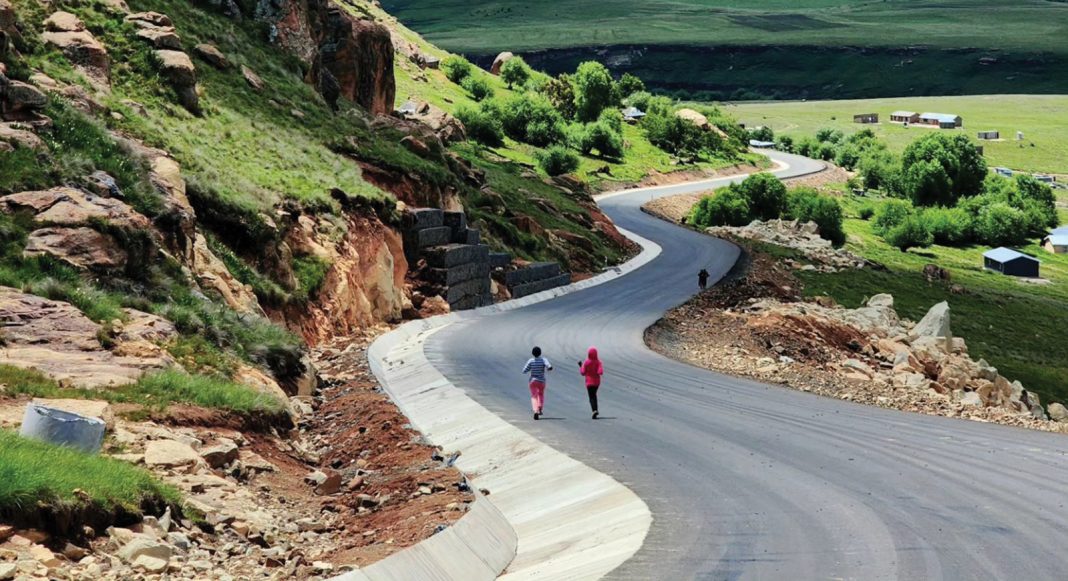
Mosae was referring to TIM Plant Hire (PTY) Ltd which entered into sub-contract with a Chinese-owned company CNQC in 2019 for the construction of the Mpiti-Sehlabathebe road in Qacha’s Nek.
The company’s accountant, Sikubutele Nqosa, revealed in February this year that at the on-set CNQC negotiated from the original figure of M190,000,000 to M109,000,000.
Nqosa said Tim Plant Hire was forced to suspend work after CNQC failed to honour an outstanding M40 158 965.16 payment.
He disclosed that Tim Plant Hire were awarded a M379,036, 817 joint contract by Maseru City Council together with Shanxi Construction Investment Group Co. Ltd (SCIG) and Shanxi Mechanization Construction Group for the Mpilo Boulevard Intersections and Links Project.
An internal agreement was then reached that Tim Plant Hire’s 30 percent share would be bought out of the contract for M7.5 million and the same company would further construct Zone 4 of the project exclusively.
“However, this arrangement was not honoured as we were only paid M4 million from the agreed amount; work on the designated zone was also not paid,” Nqosa pointed out.
Nqosa this week told this publication that the ministry of public works and transport called a meeting in May and the matter was settled out of court. And the money (M40,158,965.16) was paid CNQC in June.
“The association therefore expressed happiness for TIM Plant an association, but it is still aware that several Basotho companies have not been paid yet. For example, LSP Construction, which worked on the Ramarothole – a major national infrastructure project – has still not been paid yet the government and Chinese continue to quote it as a major success.
“So this simply says to us, there is a need for the association to speak on behalf of Basotho contractors hence we are calling on all Basotho-owned construction companies to join us so we can form one collective voice effectively put government and the Chinese in order.
“The association is membership-based; therefore, we can only act on behalf of members in circumstances where our members who were similarly placed as TIM remain, and we will mount more pressure to win,” Mosae maintained.
He added that there is a concerted effort by the Chinese firms to destabilise Basotho-owned construction companies.
He claimed that, when tendering for jobs, Chinese companies will almost always ensure they have the lowest quotation to ensure they beat their competition, after which they may subcontract Basotho companies to perform the same job under unrealistic rates.
“There is also the issue of late or non-payments of subcontractors which has led to financial ruin and even closure of some smaller firms that did not have the cash flow to stay afloat. For bigger companies, while it is easier to survive late payments, there have been instances where they attempt to poach key members of the said company thus ensuring they fail to function optimally.
“Unless the issue is handled swiftly, in a few years there will hardly be any local construction companies left and this will of course lead to higher rates of unemployment as the Chinese are also bringing in other Chinese to work in Lesotho.
“The local construction sector is being threatened and the association is addressing this very concerning matter,” Mosae said.