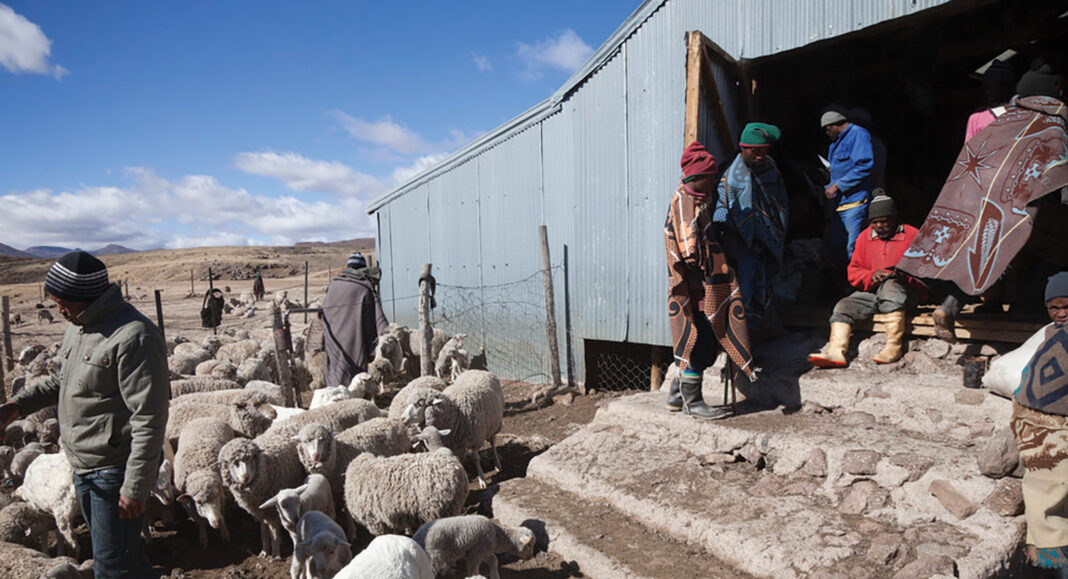

Local farmers say they are losing income because the Department of Livestock delays issuing identification marks such as tattoos, needed for animal registration.
According to government regulations, all livestock must be registered and marked to prove ownership before they can be sold. However, farmers in Semenyane, Qacha’s Nekand surrounding areas claim they have been waiting for months without progress.
Semenyane councillor, Boelane Eleck, said farmers are angry that the department has not tattooed their animals despite several promises to do so.
“Many have no choice but to sell their animals informally in South Africa, where they fetch slightly better prices, even though the trade is risky,” he told theReporter in an interview.
A farmer from Morija in the Maseru district, Thulo Mojare, said there are only eight resource centres in the area, yet only four are fully equipped.
“They have to borrow tools from one another,” he explained.
Mojare noted that the Department of Livestock often runs out of gas needed to heat branding metal used for tatooing.
“Sometimes, we’re told there are no vehicles to transport ministry workers to rural areas where animals need to be tattooed, which is a challenge,” he added.
Livestock farming remains a major source of livelihood for most Basotho, and any delay in animal identification means a direct loss of income.
Tsoelike Member of Parliament, Tŝeliso Nkoefoshe, confirmed receiving complaints from local councillors and farmers.
Nkoefoshe said he was engaging with the relevant authorities to allow temporary registration while tattooing continues.
“I have already discussed the matter with the District Administrator and will meet the Principal Secretary of the Ministry to plead that farmers be allowed to register their animals while awaiting tattooing.
Some farmers, however, reportedly resist tattooing altogether.
A bewys (ownership certificate) writer who spoke on condition of anonymity said some farmers, particularly those with smaller stock such as sheep, refuse tattoos because they believe the marks lower the animals’ value.
Others suspect tattooing could expose them to taxes or make cross-border smuggling more difficult, he said.
National Livestock Registrar, Pitso Ramokoatsi, said the department’s tattooing campaign began in 2016 and is ongoing across all districts.
He however, admitted that compliance remains low because some Basotho refuse to register or tattoo their animals because they prefer selling them in South Africa.
“In most cases, these animals are smuggled and re-marked with South African identities to enter that market legally,” said Ramokoatsi in an interview on Tuesday this week.
He added that the department has an office in Qacha’s Nek and a resource centre in Sehlaba-thebe, which work with local chiefs to organise community meetings (pitsos) for livestock marking and awareness campaigns.
“We have not stopped tattooing animals. We continue to expand our operations and buy new equipment to speed up the process,” he stated.
Livestock identification is a legal requirement in Lesotho under the Stock Theft Prevention Regulations of 2004.
Each animal must carry a unique mark – through tattooing, ear marking, branding, or microchipping – to prove ownership and curb stock theft. Once marked, animals can be registered in the National Livestock Register, allowing owners to obtain a proof of ownership certificate when selling or transporting them.
Failure to mark livestock can result in confiscation, arrest, or refusal of sale at official markets. Tattooing is preferred for smaller stock like goats and sheep, while cattle are often branded or ear-marked.
The system also supports cross-border trade by providing traceability, though some farmers complain that South African buyers prefer unmarked animals, complicating formal sales.
According to the Department of Livestock, identification is free of charge, and officers conduct marking campaigns through local chiefs and community gatherings.
In Parliament earlier this year, MP Mohlahlobi Busa asked the Minister of Local Government, Chieftainship, Home Affairs and Police, Lebona Lephema, to clarify whether bewys writers could issue certificates for unmarked animals while farmers wait to be tattooed. Responding on the minister’s behalf, Public Service Minister Mputi Mputi said the StockTheft Prevention Regulations of 2004 do not prohibit sales of animals as long as they have an identification mark – be it an ear mark, brand, tattoo, or microchip.