
By ‘Mantṧali Phakoana
The Lesotho Electricity Company (LEC) is grappling with a long outstanding M239 million debt owed by government, private and domestic users, and might be forced to resort to load-shedding should they fail to settle their dues.
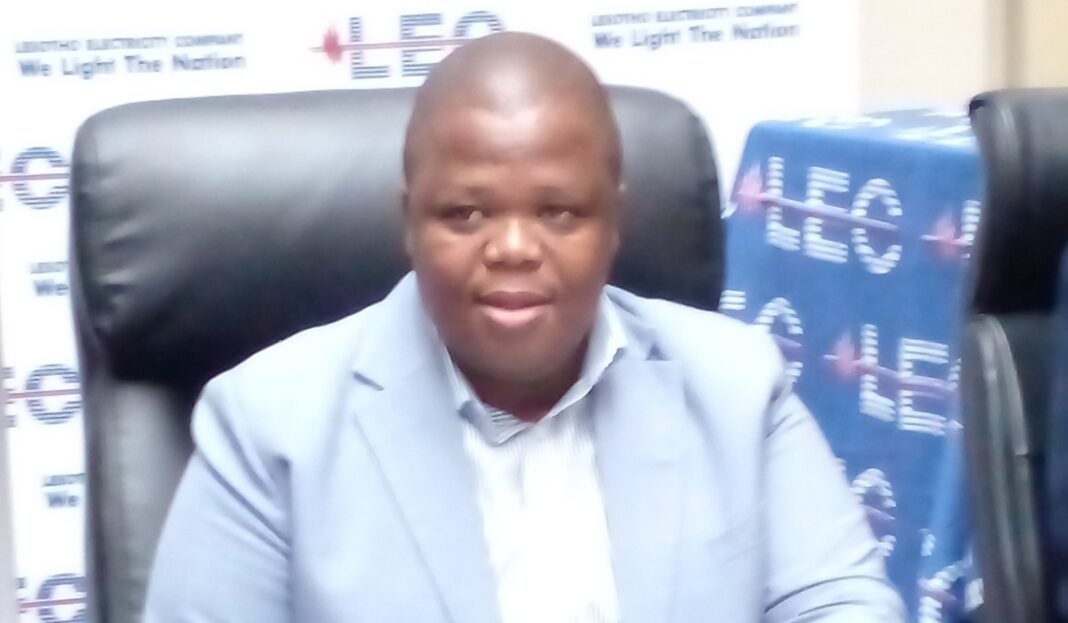
LEC managing director, Mohato Seleke told the media on Tuesday that the power utility company’s cash flow was strained and this was hampering their efforts to provide quality services and reach more consumers.
The government owes LEC a massive M80 million in unpaid electricity bills while private companies and some embassies owe M57 million. Individual users owe an additional M102 million.
The cash-strapped entity is now making yet another passionate appeal to debtors to pay up as it seeks to arrest its ballooning debt.
The struggling state-owed enterprise in March this year threatened to switch-off electricity to owing clients in a desperate move.
Seleke said it was worrisome that government ministries and departments were the worst culprits, owing the power utility a massive M80 million.
Individual users owe M102 million, part of it dating back to 2018/29, he noted, adding that efforts to collect this debt had been unsuccessful.
However, Seleke said the LEC’s position was worsened by a sharp increase in the price of electricity by South Africa and Mozambique. Lesotho imports power from the two countries to supplement its supply capacity from the ‘Muela hydropower station in Butha-Buthe.
He further indicated that Lesotho uses 196 megawatts of power, but can only generate 72 megawatts from the ‘Muela station.
“This is an indication that we are importing more than we are able to produce. And with the turbine that has been damaged for a year now at ‘Muela, the power supply has declined by 46 megawatts,” Seleke said.
South Africa increased its electricity prices by 18.69 percent with effect from April this year. This means that starting from 1 June 2023, the LEC will be paying 5.22 cents per unit during peak-times from the neighbouring country’s Eskom.
South Africa itself is experiencing long periods of load shedding due to a shortage of power. This has severely affected its industries and the lives of ordinary citizens.
“Mozambique’s hike is higher than South Africa. However, I cannot reveal the figures now because we are still in talks. But LEC is already feeling the pinch,” Seleke said.
He noted that for the fiscal year 2021/2022, his organisation spent M800 million on importing bulk power from the two countries.
He predicted that the winter period between June and August would be very difficult and critical for the LEC in terms of capacity to provide electricity as demand would be higher, especially during peak-times.
“We are trying as much as possible to convince customers to pay off their debts to avoid the worst-case scenario,” Seleke said.
He said the LEC embarked on an exercise to collect the debts two and a half years ago but with very little success.
He further warned that it was imperative that consumers settle their due so that the power utility can avoid cutting supplies as this would severely affect Lesotho’s already fragile economy.
“It is unfortunate that unlike other utility companies in the region, LEC does not receive government subsides. We are on our own and depend on electricity purchase. The responsibility we shoulder is too high.
“Lesotho’s economy has been too fragile for a very long time that it would be a serious problem if we introduce load shedding. The country has not been able to create jobs. The clothing and textile, mining, and agriculture sectors are all suffering. They would be badly affected if we introduce load-shedding,’ he said.
Seleke indicated that the LEC had only received a government subsidy of M45 million in 2014, specifically for maintenance of electricity equipment in the country. Nothing else has been received since then.
He also said that despite not getting enough government support, the organisation had so far managed to avoid load shedding which was now a common occurrence in some countries in the region.
“We should all ask ourselves as to why Lesotho has not been part of the countries hit by load-shedding. It is because of the hard work that we’re putting in to stay afloat,” he added.
Addressing the same press conference, LEC head of division customer experience Lebohang Mohasoa said their efforts to collect outstanding debts had not yielded the desired positive results.
Most debts were still outstanding, he said.
“The company is still engaging with customers to pay. But unfortunately as we do that, the debt keeps accumulating,” Mohasoa noted.