
By Seleoe Nonyane
The continued weaker loti, volatile crude oil prices, administered prices as well as the risk of El Niño present upside risks to the medium-term inflation outlook in Lesotho.
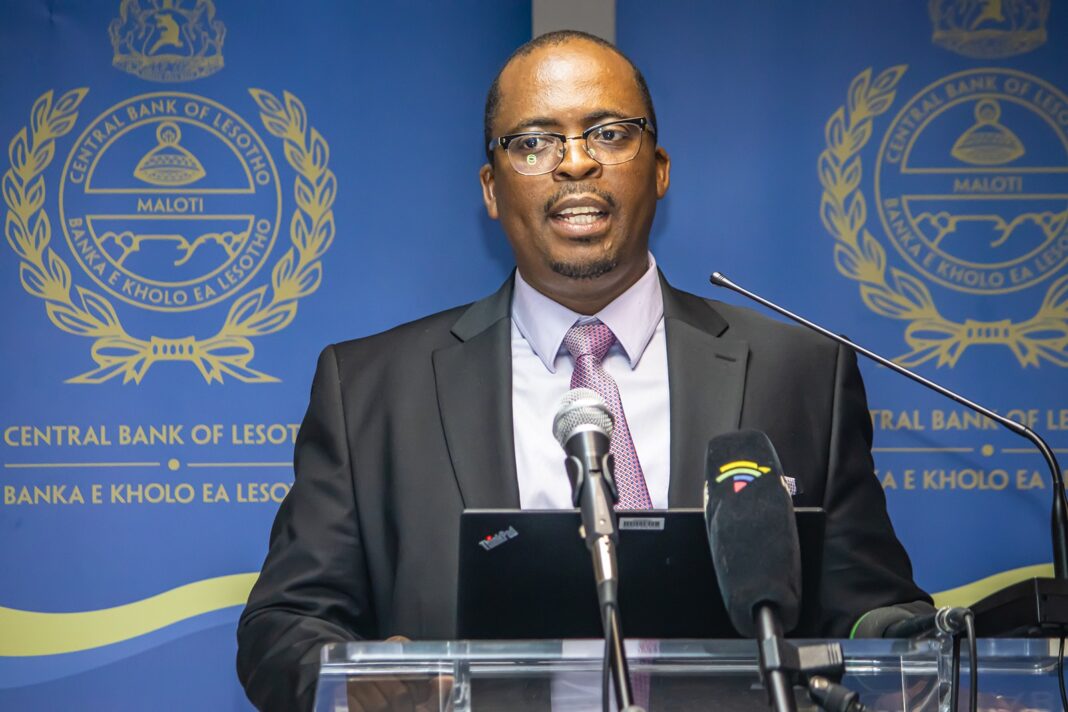
This was revealed by the Central Bank of Lesotho governor, Maluke Letete, last week after the CBL Monetary Policy Committee (MPC) held its 104th meeting.
The Committee deliberated on the latest global, regional, and domestic economic developments, as well as the developments in the financial markets.
It noted that the global economy continued to recover from the effects of the pandemic, the prevailing geopolitical tensions and the cost-of-living crisis.
However, growth is expected to slow down from 3.5 percent in 2022 to 3.0 percent in 2023 and further slow down to 2.9 percent in 2024.
Economic activity in selected advanced and emerging market economies generally slowed down in the third quarter of 2023, except for the US, where growth slightly increased mainly due to increased spending.
Inflation rates generally declined in the selected advanced and emerging market economies in October 2023 but largely remained above their target levels.
This was mostly due to decreasing food and fuel prices. Nonetheless, South Africa’s inflation rate rose during the same period.
As a result, most central banks kept their policy rates unchanged in their latest policy decisions. Short-term yields fell in most selected economies, except for China where they rose due to a recent liquidity squeeze.
Therefore, having considered the Net International Reserves (NIR) developments and outlook, regional inflation and interest rates outlook, domestic economic conditions and the global economic outlook, the MPC decided to leave the CBL rate unchanged at 7.75 percent per annum.
Letete indicated that the domestic economic activity of Lesotho rebounded in the third quarter of 2023.
He said this was due to a pickup in demand as well as improved performance in construction and services, particularly transport.
Nonetheless, the persistently weak manufacturing sector moderated growth.
Letete pointed out that the Lesotho Highlands Water Project (LHWP) Phase II project and its knock-on effects on the services sector are expected to underpin growth in the medium term
He indicated that the domestic inflation increased to 6.5 percent in October 2023 from 5.8 percent in September 2023.
“Food and energy prices coupled with weak exchange rate were the main contributors to the rise in inflation.
“Broad money supply increased in the third quarter of 2023. This growth was supported by the increase in net foreign assets and net domestic assets,” he said.
The CBL governor showed that the increase in both Net Foreign Assets and Net Domestic Assets was mainly driven by the redemption of government securities and credit extension by commercial banks.
In addition, he said, the rise in private sector credit was observed in both credit to households and business enterprises
Government operations registered a surplus equivalent to 2.5 percent of Gross Domestic Product (GDP) in the third quarter of 2023.
“During the same period, the stock of public debt declined to 59.9 percent of GDP from 61.4 percent, due to amortization and redemption of treasury bills, moderated by new disbursements and treasury bond issuances.
“The current account deficit narrowed to 1.4 percent of GDP in the third quarter of 2023 from 2.3 percent of GDP in the second quarter of 2023,” Letete said.
He explained that this was mainly due to increased surpluses in both primary and secondary income accounts.