
‘Mantšali Phakoana
The government is investigating a Chinese-owned factory accused of dumping potentially toxic chemicals into Mohokare River.
The toilet paper manufacturer, Mountain High, allegedly illegally draws water from the river for use in its mill and then discharges the waste into the same source.
This practice is said to be hazardous to human and animal health and the environment.
Investigations by theReporter have revealed that the toilet paper mill situated at the Maseru Industrial Area (Station) collects water from Mohokare River for daily operations.
The factory also releases effluent from the manufacturing process straight into the river, which separates South Africa and Lesotho. It then flows into the Orange-Senqu basin which extends across Lesotho, South Africa, Namibia and Botswana.
The sources said the factory does not have a license to draw water from Mohokare.
Also, no Environmental Impact Assessment (EIA) was conducted before Mountain High began its operations two years ago.
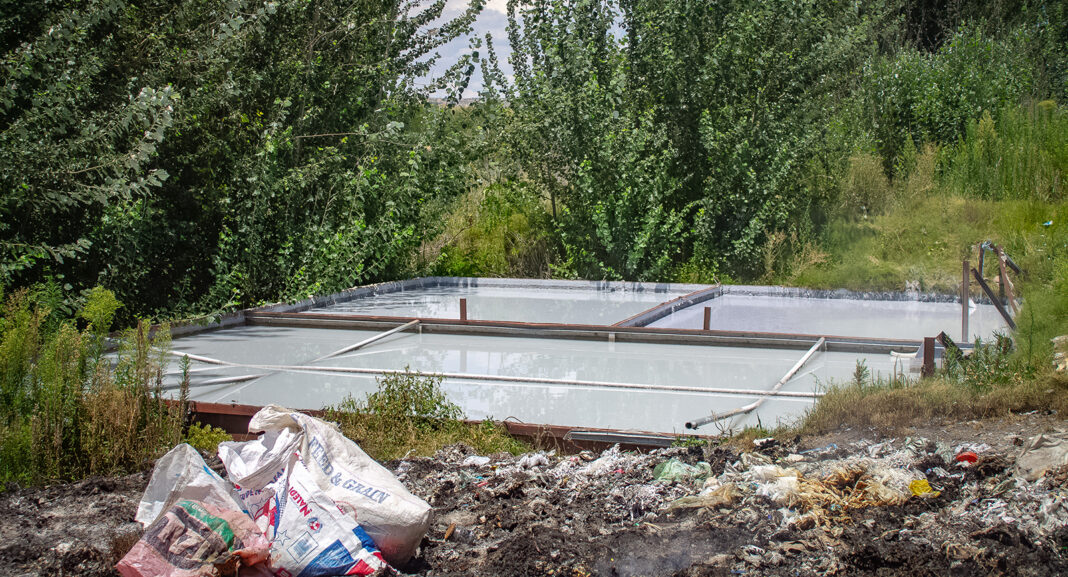
The sources also noted that the company has connected pipes transferring collecting water from the river to a small dam constructed next to it.
Similar pipes have also put to ferry used water from the factory firm to the dam, which is later released into Mohokare when the dam has reached its maximum storage level.
“Water is an absolute requirement to the manufacturing of toilet paper hence we are based next to the river.
“To make production easier, there are pipes connected at the site of the Mohokare River that collects water from the river into the firm.
“We also have other pipes collecting water that has been used to wash the toilet paper from the firm into the dam and when the dam is full, we open it for the water to flow into Mohokare River,” an employee said on Tuesday this week, speaking in condition of anonymity.
Another worker said the factory also burns waste and during rainy days, ashes and small particles of wastes flow straight into Mohokare River.
The same worker noted that government authorities have visited the company on several occasions but the situation continues unabated.
“Things have always remained the same. I suspect there is a foul play between the government and the Chinese owner but, as employees, we cannot raise such issues for fear of being victimised.”
In an interview with theReporter this week, Mountain High manager, Y Chen, said the government has never brought a complaint to the company, therefore there was no cause for concern.
Although Chen confirmed that the factory collects and releases water into Mohokare River during the manufacturing process, he disputed allegations that the chemicals could be harmful to health and the environment.
“The chemicals are harmless. We have been operating here for two years, after the previous company that had carried out the same operations for 15 years left.
“Since then, the government has not said anything. LNDC (Lesotho National Development Corporation) has not said anything, what is the problem now?” Chen quipped.
“We are here to work, not to pollute. If the government has a problem with that, they should say it to us,” he added.
Contacted for comment yesterday, senior environment officer pollution controller in the ministry of environmental, Kobeli Tšasanyane, said relevant government institutions conducted an assessment to examine the suspected contamination of water at Mohokare River.
The assessment was conducted by a team of experts from the departments of environment and water affairs, police crime unit, ministry of health, LNDC, Water and Sewage Company (WASCO) and Maseru City Country (MCC) on August 30, 2023.
It sought to examine if there is possible contamination of chemicals caused by factories at Mohokare, Tšasanyane said.
He noted that the team has not finalised its report as more investigations around the matter are underway.
However, he believes that there was nothing hindering LNDC from taking action against the company as the entity responsible for attracting investors.
Tšasanyane said he was yet to study the findings to establish if the chemicals in the water are harmful or not.
“These things happen if there is no EIA (Environmental Impact Assessment) conducted before an investor commences operations. It is very unfortunate that the institutions responsible to hold them accountable are not acting.
“South Africa has already raised concern over pollution from Maseru catchments. If they could be aware of this one too, it would really tarnish our relationship,” he pointed out.
He added that the matter needed to be treated carefully as it is complex and involves various stakeholders with different intentions.
“It would be expected that by now solutions would have already been found but because of our workload it might take us time to address all the issues surrounding this matter.”
Tšasanyane further indicated that another reason that might delay the investigations is the recall of the police crime unit operating in the ministry of environment this week.
He also noted that even if the factory was to collect water from WASCO, it would have to meet limits set by water and sewage company.
“We need also to establish how the factory collects water from the river without a license and also why was there no EIA conducted before it commenced operations.
“There are a lot of things happening there and they need to be uncovered,” he said.
Research from the University of Florida in the United States last year revealed that all the toilet paper from most regions across the world contains toxic “forever chemicals” and might be a significant source of water pollution.
The report also revealed that toilet paper may play a role in the contamination of groundwater with potentially harmful substances called PFAS.
“Per-and polyfluoroalkyl substances are found in a wide variety of consumer products, including cosmetics, cleansers, and firefighting foams.
“PFAS are suspected of playing a role in a variety of conditions, including cancer, reduced immunity, and reproductive and developmental problems. Exposure to PFAS through drinking water puts people’s health at risk, showing that PFAS pose significant health and environmental risks.”
While there are no confirmed reports proving the negative impacts of the chemicals released from the toilet paper to the river, the practice contravenes Lesotho’s Environment Act 2008, Section 19 (4) of Water Act, 2008, which clearly states that no persons shall damage, destroy or cause any harm to a natural spring.
According to this law, it is the role of the LNDC to ensure that industries abide by the Lesotho laws.
It also renders Lesotho in breach of the SADC Protocol on Shared Water courses.
The Delegation of the European Union (EU) to Lesotho recently joined ReNOKA and the Orange-Senqu River Commission (ORASECOM) to raise awareness on plastic pollution and its impact on the health of rivers, water quality, wildlife and the communities who depend on these water resources.
ORASECOM is responsible for managing the resources of the Orange-Senqu River basin – linking the initiative to an Orange-Senqu ‘Source to Mouth’ transboundary campaign for primary school students in Lesotho and Namibia.
Mountain High has also been accused by street vendors operating at the industrial area for polluting the environment and threatening their businesses.
Liau Lemphane, one of the street vendors selling fast food said the firm connected another pipe next to its main gate which often discharges oily water from the firm.
The water flows through to his shack based next to the firm, he added.
“The smell from the water is very foul and it keeps my customers away. I raised this concern with the MCC three times but no action has been taken to date.
MCC public relations officer, Lintle Moerane said they were not aware of the said factory and had not received any concerns.
However, she was quick to blame street vendors for having a tendency of “complaining” to the media before approaching relevant institutions for action to be taken.
“I am not even aware of the company you are referring to but what I know is that street vendors have a tendency of complaining to the media before approaching us. Nevertheless, factories are not the responsibility for MCC but LNDC,” Moerane noted.
LNDC had not responded to questions sent by this publication through email by the time of going for printing last night.