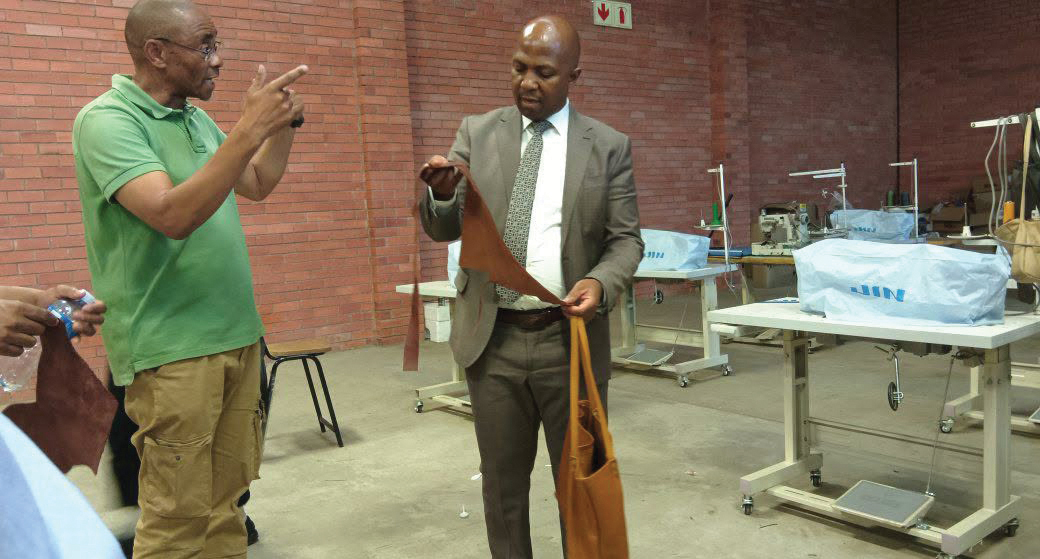

Lesotho’s Technical and Vocational Education and Training (TVET) institutions are failing to equip graduates with skills required by the country’s growing manufacturing and leather industries.
This in turn leaves businesses struggling to find industry-ready workers despite increasing demand for their products.
Owners of Zeri Leather and Beesdam factories this week raised two concerns which point to a broader challenge facing the country.
They said there is need to ensure that education and training programmes respond directly to the needs of businesses seeking to grow, improve product quality and compete in demanding markets.
Zeri Leather owner Masopha Moshoeshoe told theReporter in an interview that outdated teaching methods, lack of exposure to modern fashion and manufacturing trends as well as a disconnect between training programmes and market demands are widening the skills gap.
This threatens the industry’s ability to expand and compete in regional and international markets, he noted.
Moshoeshoe said the biggest challenge facing his factory is a shortage of skilled workers, arguing that existing training institutions are not adequately preparing students for the realities of the modern industrial environment.
“The biggest need in my factory is skill,” Moshoeshoe said, adding that the country’s TVET institutions were struggling to produce graduates with the practical competencies required by the industry.
The problem stems from a training system in which instructors who graduated decades ago continue to teach using methods and that have not kept with developments in the industry.
He argued that the industry needs workers who understand contemporary fashion trends, customer demand, product development and the changing dynamics of the global leather market.
“The skills are not there. The schools cannot produce the skills,” Moshoeshoe said, calling for the establishment of a dedicated leather training institution that equips students with relevant specialised skills.
Such an institution could help address the shortage of specialised training opportunities, he added, citing that even within the Southern African Development Community region, there are few strong institutions dedicated to developing skills for the leather sector.
Moshoeshoe claimed that the shortcomings of existing training programmes had persisted for years without sufficient scrutiny, because Lesotho’s leather industry was previously underdeveloped.
However, as businesses move further up the value chain, the gaps in training and skills development are becoming increasingly apparent.
He maintained that training institutions must be aligned with industry needs if Lesotho is to develop a competitive manufacturing sector and take advantage of opportunities in regional and international markets.
The concerns were echoed by Beesdam General Manager Mantoetse Shoepane, who also pointed to a mismatch between the skills graduates possess and those required by industry
Shoepane said Beesdam serves the South African market and is expanding its production capacity, a move expected to create additional employment opportunities.
The company specialises in changing vehicle interiors, including the production and fitting of leather car seats. It currently employs 120 people and intends to increase its monthly production of leather car seats from 600 to 1,000 as it expands its operations.
Minister of Trade, Industry and Business Development Motlatsi Maqelepo acknowledged the need for stronger collaboration between industry and the Ministry of Education and Training, particularly in ensuring that TVET courses prepare students for employment in manufacturing.
Maqelepo said his ministry needed to facilitate engagement between industrialists and TVET institutions so that training programmes could be reviewed and aligned with the skills required by employers.
“We need to increase TVET schools, but we are not doing it correctly,” he said, calling for industrialists to engage directly with the Ministry of Education and Training.
Industry experts should also be given opportunities to share their knowledge and expertise with training institutions to ensure that students acquire practical, relevant and up-to-date skills.
Maqelepo indicated that his ministry had been tasked by the government with advancing the industrial sector, making collaboration with manufacturers essential to achieving that objective.
The government recognised the important role manufacturing and textiles play in generating foreign income and providing employment for Basotho.
The minister said visits to manufacturing facilities this week were intended to help the government understand how businesses operate, identify the challenges they face and determine what support is needed to enable them to grow.
The government had recently established an inter-ministerial task team involving major industry players to hear their concerns and identify ways of addressing challenges affecting the sector.
One of the companies highlighted was Adient, an international firm operating in Lesotho that manufactures seat covers for high-end vehicles and handles products with complex specifications.
Maqelepo said Lesotho needed to move towards producing more complex and higher-value products rather than relying on less sophisticated manufacturing activities.
He argued that manufacturing more complex products could help make the country’s industry more resilient during periods of economic disruption and changes in international tariff regimes.
The minister also cited Zeri Leather, a locally owned company receiving orders from international markets but facing difficulties in finding workers with the skills required to fulfil its production needs.
“The challenges experienced by these companies highlight the importance of linking industrial development with education and skills training,” he stressed.