A 29-year-old entrepreneur from Baroeng in Botha-Bothe is turning her experience selling shoes into a leather manufacturing business, with ambitions to create employment for young people and establish a proudly Basotho footwear brand.
Karabelo Sebokoana ’s journey began while she was attending school in Vereeniging, South Africa, where she sold muffins on the streets. After completing school in 2019, she returned to Lesotho and started working at a spice shop in Hlotse in November 2020.
That same year, she met a shoemaker in Katlehong, South Africa, who produced footwear using African print and Seshoeshoe fabric. She began buying and reselling his shoes in Lesotho, an experience that introduced her to the market and inspired her to learn how to manufacture footwear herself.
After leaving the spice business in 2022, Sebokoana committed herself to shoemaking. She learned the basics from a shoemaker in Maseru in 2023 before attending a professional shoemaking school in South Africa in 2024.
Her training equipped her with skills to produce various types of footwear, including formal shoes, casual shoes, boots, sandals, ladies’ shoes and school shoes.
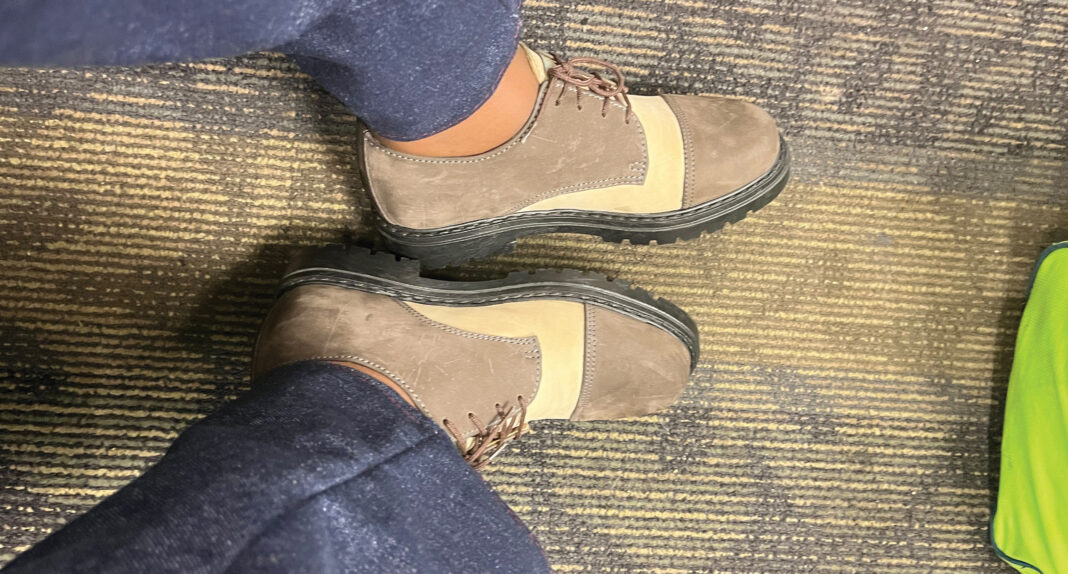
Unlike businesses that only resell imported footwear, Sebokoana’s enterprise manufactures shoes using genuine cow leather. The materials include lining, leather or thermoplastic rubber (TPR) soles, industrial glue, thread, eyelets and laces, all sourced from South Africa because suitable supplies and specialised equipment are not readily available in Lesotho.
Production begins with selecting leather according to the type of shoe. The material is cut according to patterns, and the upper parts are stitched using industrial sewing machines. A shoe last, a mould shaped like a foot, gives the footwear its form before the upper is attached to the sole. Each pair then undergoes finishing, polishing and quality checks.
Establishing the business required substantial investment. Sebokoana started with R50,000 raised with the support of her parents to cover her training, purchase her first machine and buy leather.
The cost of equipment and materials remains a challenge. Industrial leather sewing machines cost between R11,000 and R16,000 each, while a shoe last costs approximately R350. Importing genuine leather also increases production costs.
Competition from cheap synthetic and second-hand footwear adds pressure, but Sebokoana differentiates her products through quality, durability and custom sizing.
Support from the Competitiveness and Financial Inclusion Project (CAFI) project has helped her purchase additional equipment and buy leather in bulk, allowing her to increase production and expand her customer base.
Her customers include professionals seeking formal shoes, young people looking for casual footwear and boots, women interested in leather shoes, and parents buying school shoes.
Sebokoana markets her products through social media platforms Facebook, WhatsApp, TikTok and local trade fairs, while word-of-mouth recommendations help attract new customers.
Sebokoana’s ambitions extend beyond growing her own business. She hopes to transform her workshop into a small factory producing school shoes and formal footwear in bulk, contributing to efforts to reduce Lesotho’s dependence on imported shoes.
Over the next two to five years, she plans to create between 50 and 100 jobs for young people and train them in cutting, stitching and shoe design.
Her vision is to demonstrate that manufacturing can provide an alternative path for young Basotho seeking economic opportunities. Through practical skills, determination and support for local enterprises, she hopes to build a business that creates jobs rather than simply sells imported products.
Ultimately, Sebokoana wants to see leather footwear carrying the “Made in Lesotho” label sold across Africa and beyond.