
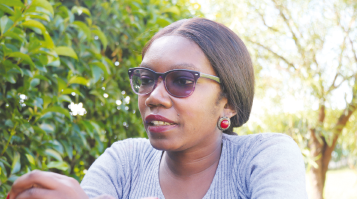

When a 14-year-old girl who was still in primary school was made pregnant by a Herder in her village in Mafeteng, 77 kilometers from Lesotho’s capital Maseru, she was married off to the Herder by her parents, much to the chagrin of her community who could not do anything about the matter.
After being trained on mainstreaming protection, including child protection, Gender Based Violence (GBV) and migration in humanitarian emergencies under support from the Central Emergency Response Fund (CERF), a Peer Educator in the area has vowed never to let something like this slide, but will take necessary action such as reporting to the police, as she has learnt that child marriage is illegal.
“During the training, we were made aware that ‘Yes’ from a child does not mean anything. I will therefore report these kind of cases, and if parents agree, I will try to advise them,” states the Peer Educator ‘Mabohlokoa Tsatsi who was among those trained in Mafeteng district under the CERF funded project.
Her work as a peer educator includes sensitizing young people from the age of 10-24 on life skills, sexual and reproductive health, relationships, intergenerational relationships and establishing income generating activities.
Her Colleague, Paul Ramose who is also a Peer Educator said the training made him aware that drought exacerbates intergenerational relationships and forced marriages, particularly marriages into wealthy families.
In his area of work in Mafeteng, a man who had returned from working in the South African mines and is alleged to have befriended a mother to a 13-year-old girl, occasionally buying her alcohol, was allowed to marry that 13-year-old girl by her mother despite protests by her family. Eventually, a compromise was reached that the girl should stay married to the old man but the marriage should not be sexual until the girl reached the age of 18.
“I have realized after the training that if I do not take action when I see these kind of problems, I will become part of them and will also be guilty of the crime. So, from now on I will at least inform the police or other stakeholders,” he stated.
In another village, a young girl was the last person in a taxi. Instead of dropping her off where he was supposed to, the taxi driver delivered everybody else except her and then allegedly raped her. She managed to convince her rapist to take her home where she was living with her grandmother. When her grandmother found out that she had been raped, she suggested that the taxi driver should marry her.
“The girl, bloody as she was, went by herself to report the matter to the police without being supported by anyone,” stated the Chief of the area Chief Maphathe Maphathe who was also among those who participated in the training.
He learnt how to deal with these kind of cases particularly how to approach and support rape victims. He also discovered that drought brings about food insecurity and poverty, resulting in increased theft. “Rape cases are also likely to increase because of drought as women have to walk long distances to collect firewood and water,” he added.
After the training, he was going to bring community policing members in his village together and sensitize them on GBV. “I will make them aware of how GBV, just like human trafficking is agonizing to victims,” he emphasized.
Meanwhile, in her area of work, ‘Mamotsoko Motlomela who is a Community Clinic Linkages Officer came across a case where a man prohibited his wife from taking anti-retroviral treatment. “She had started on ART when her husband was still working in South Africa, when we tracked on her to find out why she was no longer taking her medical supply, we realized that her husband was forbidding her from taking the treatment.
After this training, it will be easier for me to refer this kind of cases. What has been most outstanding for me in the training has been mainstreaming gender in my day to day work,”she added.
Other chiefs who participated in the training said they had also learnt how to address cases of gender based violence and provide the necessary support. Chief ‘Matebatso Letsie of Ha Ralintsi and Chief ‘Makhojane Khojane of Ha Khojane promised to organize public gatherings to sensitize people under their jurisdiction on GBV and human trafficking.
The training have been for, among others, technical teams from different ministries and implementing partners and organizations including media on protection mainstreaming, chiefs, counselors and young people.
Lesotho has experienced an El Niño induced drought with below-average rainfall during the 2018-2019 rainy season.
UNFPA, under the CERF emergency fund therefore embarked on a cross-sectoral emergency response to communities affected by the drought in the five districts of Maseru, Mafeteng, Mohale’shoek, Quthing and Qacha’snek.
Under the project, which UNFPA, the United Nations Population Fund has undertaken jointly with IOM and UNICEF, focus is on providing emergency protection interventions such as sensitization on GBV and harmful cultural practice trafficking in persons and child marriage. The six months’ project is intended to end in June this year.
UNFPA works with partners to develop tools to address gender-based violence in humanitarian contexts.
This is based on the premise that gender based violence may become more acute in the wake of a natural disaster. Victims are usually women and adolescents, whose vulnerability is exacerbated in the chaos of a crisis.


