
By Neo Kolane
When addressing a two-day high level dialogue nutrition and financing in March last year, King Letsie III called on government and development partners such as the private sector to step up efforts to fight malnutrition.
In compliance with this clarion call, local insurance company Alliance Insurance in partnership with Rotary of Maseru, Maluti and Ladybrand, the ministry of health, Food and Nutrition and Coordinating Office (FNCO) and Baylor College of Medicine are working hard to break the intergenerational cycle of malnutrition.
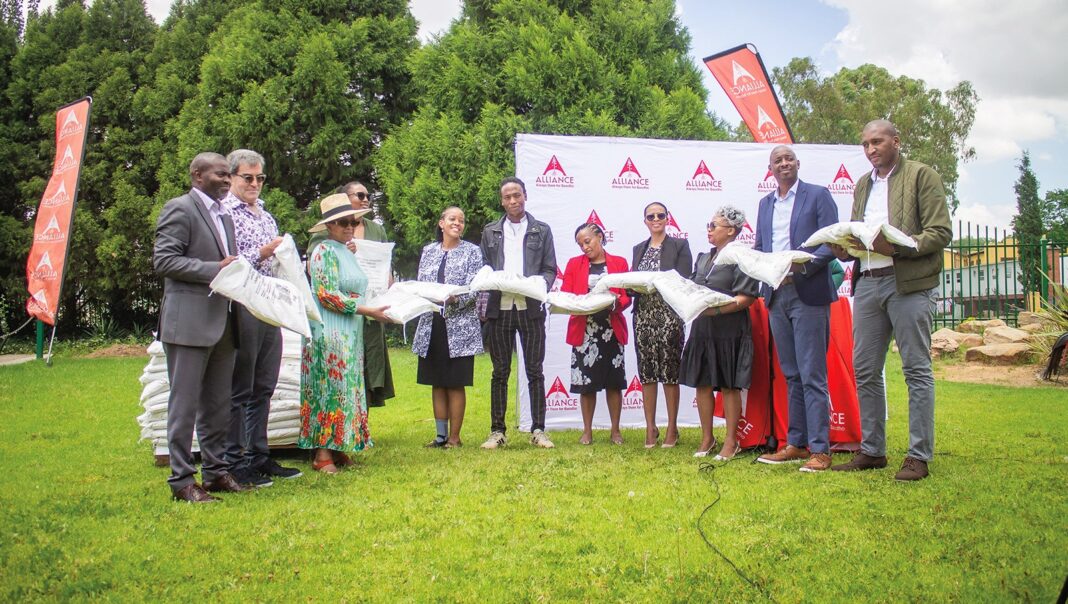
Alliance handed over a sizeable donation of fortified meals to children under the care of Baylor Foundation Lesotho in six different districts of the country.
Alliance contributed M300 000 for 3000 bags of 5kg of fortified porridge.
Speaking at the handover, Alliance Insurance’s head of group marketing and corporate communication, ‘Makeabetsoe Mabaleha, said the project aims to conquer micronutrient malnutrition and reduce the prevalence of anaemia in children.
Mabaleha said this is in line with the company’s 30-year anniversary celebrations and its Corporate Social Investment (CSI) initiative.
“Through the CSI committee, we noted that hunger and malnutrition have been compromising school enrolment, regular attendance and learning, especially in primary school-aged children and adolescent girls.
“The initiative is meant to help children reach their full potential and become productive adults while breaking the intergenerational cycle of malnutrition,” she indicated.
Mabaleha also noted that their main objective is to leave a lasting legacy in the communities they serve.
She added that micronutrient deficiencies blight the lives of billions of individuals and can trap generations in a vicious cycle of poverty.
The Global Nutrition Report (GNR) in February 2023 says Lesotho is on course to meet two of the global nutrition targets; Maternal infant and young child nutrition.
The report is an independently produced annual stock-take of the state of the world’s nutrition.
According to nutrition experts, malnutrition refers to deficiencies or excesses in nutrient intake, imbalance of essential nutrients or impaired nutrient utilisation. The double burden of malnutrition consists of both undernutrition and overweight and obesity, as well as diet-related non-communicable diseases.
Macronutrient undernutrition (protein-energy undernutrition) deprives the body of energy to sustain itself. To compensate, it begins breaking down its own tissues and shutting down its functions. This begins with its body fat storages and then proceeds to muscle, skin, hair and nails. People with protein-energy undernutrition are often visibly emaciated. Children may have stunted growth and development.
One of the first systems to begin to shut down is the immune system, which makes undernourished people highly prone to illness and infection and slower to recover.
Cardiac activity also slows down, leading to low heart rate, low blood pressure and low body temperature. People may feel faint, weak and apathetic about life. They may lose appetite, and parts of their digestive system can atrophy.
A report showed that between July to September 2023, 245,000 people in rural Lesotho faced high levels of acute food insecurity. This called for urgent action to reduce food gaps, protect, and restore livelihoods as well as prevent acute malnutrition.
The executive director of Baylor College of Medicine, Lineo Thahana, said as a lower middle income country, Lesotho is significantly affected by poverty.
It also faces a triple burden of malnutrition, high levels of stunting, micronutrient deficiencies and overweight across all age groups, she noted.
Thahane said according to a World Food Programme (WFP) country brief of May 2023, 24.1 percent of Basotho are extremely poor and living below the poverty line.
She said the GNR further states that 34.6 percent of children under the age of five are affected by stunting which is above the average for the African region of 30.7 percent.
“With a chronic lack of adequate food and recent increases in the food insecure population as noted in the Lesotho Vulnerability Assessment of 2022, the nutrition agenda becomes very critical. This is particularly true for children and adolescents living with HIV, who are more at risk of malnutrition, and has been exacerbated for all your people by the impact of the COVID-19 pandemic.
“Currently, Baylor Foundation Lesotho operates seven clinical sites throughout the country and are funded by the ministry of health. Once malnutrition is advanced, serious clinical complications are more likely and curative measures are more costly.
“Presently, out of 2, 481 boys and girls between the ages of four and 14 years that we serve, we have 245 currently affected by mild malnutrition, 437 affected by moderate malnutrition and 66 affected by severe acute malnutrition. In addition to those, we have another 800 who are in need of assistance as a preventive measure to keep them from transitioning into more serious forms of malnutrition,” Thahane pointed out.
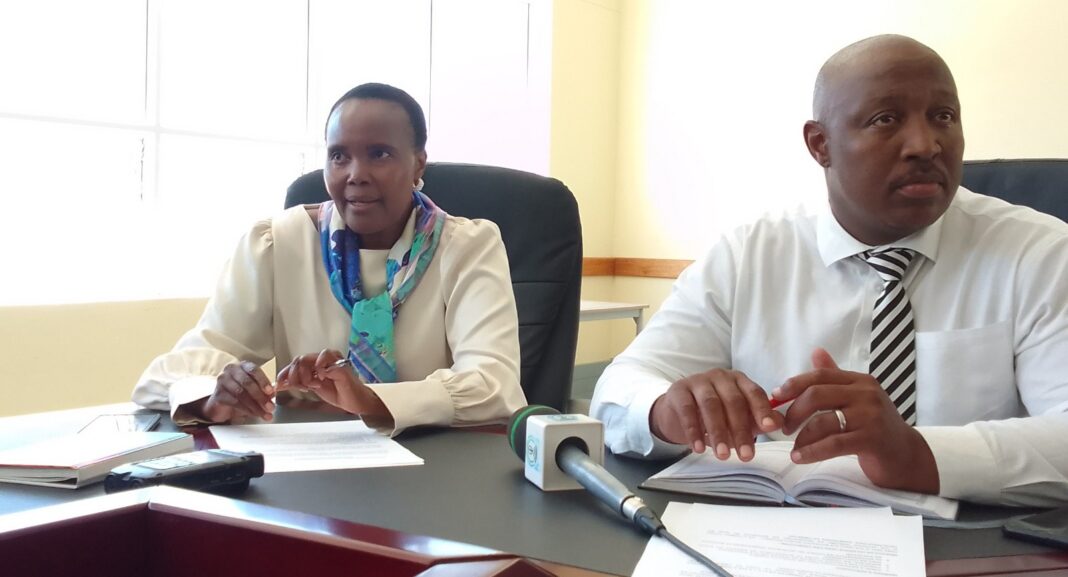
FNCO’s ‘Masekonyela Sebotsa said Lesotho is struggling with chronic malnutrition whereby stunting is the main problem. FNCO falls under the prime minister’s office.
Sekonyela said 34.5 percent of children in Lesotho under the age of five who are stunted with Vitamin A and iron deficiency.
“The problem is inadequate food intake and lack of dietary diversification. Our concern is that malnutrition impacts negatively on the economy of the country.
“Right now, Lesotho is spending M1.9 billion on the costs of malnutrition, and those costs are from the health sector.
“On the education side, a malnourished child is unable to listen, and there are more repetition rates and that is affecting our education sector,” she stated.
Sebotsa also disclosed that the government has passed a regulation for maize meal and corn flour to be fortified with the necessary micro nutrients.
She further indicated that beneficiaries need to be followed up on with FNCO.
“We need to work together as government and the private sector. We are going to work together with Baylor to make sure those beneficiaries are followed up.
“The ministry of agriculture also has a hand as it should guide the beneficiaries and advise them on dietary diversification,” Sebotsa noted.
She added that the ministry of education also makes sure children get proper meals.
King Letsie III who is the African Union Nutrition Champion says failure to translate political commitment into action remains a primary reason for the low priority that food and nutrition interventions receive from national governments.
“Therefore, generating country-level political commitment, and translating those commitments into action, backed by adequate financial and human resources, will be critical in accelerating the progress we make towards achieving the 2025 targets,” he notes.
On December 1, 2016 King Letsie III was appointed as FAO’s newest Special Ambassador for Nutrition by the Organisation’s Director-General, José Graziano da Silva in Rome.
According to the Food and Agriculture Organisation (FAO), the announcement was made at a high-level International Symposium on Sustainable Food Systems for Healthy Diets and Improved Nutrition.
The meeting explored country-level challenges and successes in the nutritional reshaping of food production, processing, marketing and retail systems.