
‘Mantṧali Phakoana
ReNoka (We are a River) held a farmers’ market to promote the sale of locally produced and organic horticultural goods in Maseru on Saturday.
ReNoka is an initiative by the government jointly funded by the European Union (EU), the German Federal Ministry of Economic Cooperation and Development (BMZ) and implemented by the Deutsche Geselleschaft fur Internationale Zusammenarbeit (GIZ).
The farmers’ market – the first of its kind – offered a huge range of local products from fresh organic vegetables and food such as milk, yoghurt, honey, biscuits, beans, maize, as well as hand crafted items including clothes, accessories, jewellery, paintings and soap.
In an interview with theReporter, ReNoka coordinator Makomoreng Fanane said the market was an opportunity for local farmers to showcase their products and interact with potential consumers.
He indicated that the market was part of initiatives implemented by ReNoka and the government through its various ministries to address issues of land degradation and soil erosion.
“We are also aiming to ensure sustainable supply of water from small and larger rivers and improve our rangelands,” he noted.
Fanane said the market follows community mobilisation within the six out of 74 sub-settlements using the natural boundaries of rivers in Lesotho. They will be upscaling to 18 sub-settlements this year.
Through the mobilisation, ReNoka and its partners are pushing decentralisation and giving communities a chance to implement programmes that will benefit them and help reduce land degradation.
“Our main aim for sustainability is community ownership, all the plans implemented in the villages under our line of duty should originate from the community.
“While we were interacting with the community, we learned that many Basotho were capable of producing but the problem was the market; even the sale of livestock was a challenge since there is lack of a well-developed market.
“As a result, the farmers’ market is a response to the challenge of lack of market,” Fanane said.
The next market will be held on September 30 2023.”
According to Fanane, farmers’ markets have tangible economic, environmental and social benefits from preserving biodiversity to providing pathways for youth in agriculture to empowering women.
He indicated that the market has been transformative in bridging the gap between rural and urban communities by promoting knowledge-sharing.
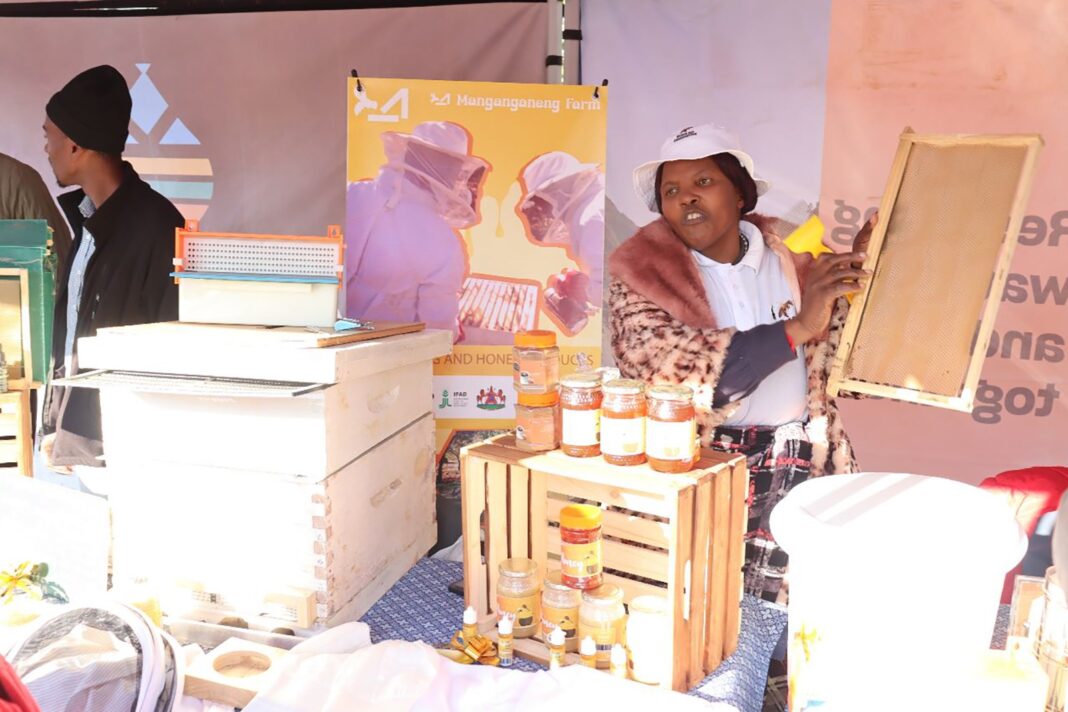
On her part, founder of Manganganeng Farm in Pulane in the Berea district, ‘Mamoiphepi Letsie said if held often, the farmers market could contribute to the economy of the country and create more jobs.
She noted that the platform gave local farmers exposure to market their products and make them known to consumers who did not even know they were existing.
“This kind of initiative needs to be done often, at least once a week. It was really a good experience for me to interact with customers and brief them about the importance of bee products.
“I enjoy mingling with customers and bringing fresh produce that people can use because I know satisfying the customer is always best.
“I was able to sell all my products; vaseline, lip bulm, Propolis and honey and got M2900 cash,” she said.
Letsie explained that bees are essential for the health of people and the planet.
Honey and other bee products have medicinal properties and the role of bees as pollinators makes them vital food supplies, she added.
However, she said a rise in factors such as pesticides use and urbanisation means that bees are currently in decline, negatively affecting many of the Earth’s ecosystems.
“A loss of bees affects honey supplies, but more importantly, world food security and biodiversity. Without them, the world could be a very different place,” she said. According to the Food and Agriculture Organisation (FAO), food security, nutrition and the health of the environment depend on pollution. Bees and other pollinators contribute to 35 percent of the world’s total crop production, pollinating 87 percent of 225 leading food crops worldwide.