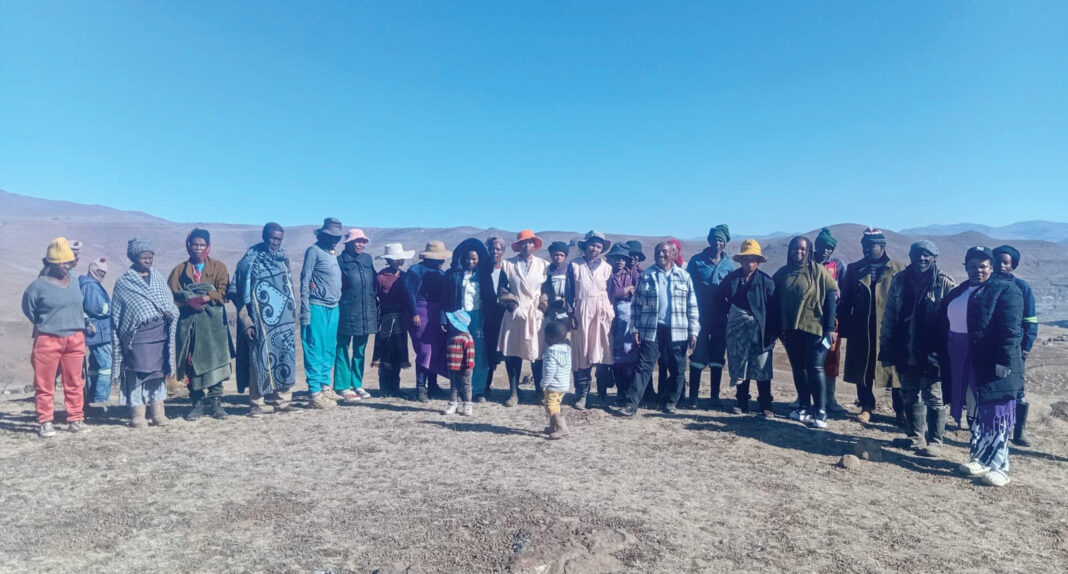

For the 39 households of Ha Konki in Mokhotlong district, the Polihali Dam project threatens far more than their homes and land. It puts at risk the natural resources that sustain their livelihoods, healthcare and livestock, leaving residents questioning whether their concerns are being taken seriously by the Lesotho Highlands Development Authority (LHDA).
As the construction of the Polihali Dam progresses, villagers fear losing vital water sources, grazing land and indigenous medicinal plants they have depended on for generations. Their concerns are compounded by uncertainty over compensation and whether they will eventually be relocated.
With dam construction approximately 50 percent complete by mid-2026 and impoundment expected during the 2027/2028 rainy season, the community says time is running out for meaningful solutions.
At the centre of the dispute is a growing disagreement over the impact of the project, with residents insisting that their livelihoods and access to natural resources are under threat, while LHDA maintains that Ha Konki is sufficiently far from the reservoir to remain safe.
Speaking to theReporter this week, resident Malebellang Shai questioned the relocation and compensation arrangements, saying the community was losing essential natural resources against its will while promises made to affected households remained unfulfilled.
She said the loss of local water sources was particularly worrying because residents depended on them both for domestic use and livestock.
“We also have a spring that we rely on whenever the taps run dry. Our livestock also drink from this spring, which the community dug specifically to provide water for its animals,” she noted.
Shai said the spring was no longer accessible because the water project had taken it over.
“Does this mean the project expects us to give up our livestock as well, when we have nowhere else to get water?” she asked.
For another resident, 32-year-old Tebello Leleka, the threat goes beyond water and grazing land to the possible disappearance of indigenous plants and traditional medicinal resources.
She said residents relied on medicinal herbs and plants to treat various illnesses, including conditions associated with swelling and fever. The same plants were also used in traditional remedies for treating livestock.
Leleka argued that these resources should have been relocated to alternative areas before they became inaccessible, but said this had not happened, leaving villagers uncertain about how they would maintain their traditional healthcare practices.
The community’s concerns also extend to its geographical location and the possibility of being left behind as surrounding areas are affected by the rising reservoir.
Resident Makonono Leleka said some households affected by the Polihali project had received compensation for their fields, land and trees, while others were still waiting for payments despite earlier assurances.
“However, we have heard nothing about what will happen to our grazing land and medicinal plants, even though our village is very close to the reservoir,” she noted.
She also stated that residents had repeatedly sought clarity about their position between the eastern and western reservoirs and whether they would eventually be relocated.
However, they were reportedly informed that relocation would not be necessary.
“We are worried that these rocks could eventually give way, causing us to fall into the reservoir. But the authorities say they cannot relocate us because there are still other villages near the reservoir,” she added.
Leleka further warned that the filling of the reservoir could submerge medicinal plants or make them inaccessible, depriving residents of resources they have traditionally used for treating both people and livestock.
“All our medicinal plants will end up submerged in the reservoir. We used to dig for certain medicinal plants, including hloenya and phate ea ngaka, while others were used to treat livestock. We will have nowhere else to collect them. This will make life extremely difficult for us,” she said.
The concerns raised by residents have also drawn support from Lenka Thamae, a policy analyst and adviser at Policy, Environmental Justice and Water Resources Advocacy (PEWA), who believes Ha Konki should be relocated.
Thamae identified two main reasons for relocation: the community has reportedly lost approximately 50 percent of its grazing land, and relocating only some households while leaving others behind would further divide the village.
He argued that Ha Konki falls under the jurisdiction of one chief and should therefore be treated as a single community in decisions concerning relocation and compensation.
Thamae also challenged the broader approach to development projects, arguing that communities living in areas rich in natural resources should share in the benefits rather than bear the consequences of development.
“We want a share of the benefits generated by dams, mines and other natural resources. We want to live!” he said.
He maintained that decisions affecting Ha Konki should be made in consultation with residents, arguing that communities themselves are best placed to identify and protect their natural resources.
“It is the people who know their situation; they know where and how to protect their springs. The water sources are the property of the people, and LHDA should respect this. All environmental matters should be addressed with the full participation of communities after they have been sufficiently empowered,” Thamae added.
LHDA rejects calls for relocation
However, LHDA has dismissed claims that Ha Konki is in danger from the rising reservoir, insisting that the village is located at a safe distance from the water.
Senior Public Relations Officer at LHDA, Malakeng Hloma, said Ha Konki was different from Tsekong village, which is being relocated because some households fall below the reservoir inundation line, while others would be left on an island once the reservoir fills.
“Ha Konki village is safe as it is far away from the reservoir. The closest point, located on a gentle slope, is more than 500 metres away from the reservoir, while other parts of the village are more than 1,000 metres away,” Hloma noted.
He further dismissed concerns about possible slope failure, maintaining that the reservoir would not threaten any homesteads.
According to Hloma, geological and slope-stability assessments are unnecessary because Ha Konki is not situated on steep slopes in relation to the reservoir.
He said areas affected by reservoir inundation would be addressed through the project’s resettlement programme, while a feeder-roads project would upgrade roads around the reservoir to restore access where existing routes might be disrupted.
On concerns about the loss of medicinal plants and other natural resources, Hloma said LHDA had conducted general assessments in consultation with villagers to identify affected resources and facilitate communal compensation.
He explained that residents had also received compensation for the loss of individual resources, including trees and medicinal plants.
“Intensive and extensive consultations were conducted to inform communities about the loss of their natural resources. They were compensated for the loss of individual resources they had, such as trees and medicinal plants,” he said.
Hloma further maintained that LHDA had rescued medicinal plants from areas earmarked for inundation and relocated them to the Katse Botanical Garden.
He pointed out that residents were free to establish botanical gardens at household or village level to preserve medicinal plants and indigenous species, adding that the Authority was prepared to provide training to interested community members.
“LHDA is ready to provide training on how to preserve medicinal plants to those interested. Residents are also welcome to establish homestead botanical gardens and plant medicinal plants if they so wish,” he said.
Hloma indicated that some households relocated under the project had planted medicinal plants at their new homes.
He acknowledged, however, that previous attempts to establish village and homestead botanical gardens during Phase I had failed because the gardens were not adequately maintained.
“Communities and individuals interested in establishing conservation areas will be guided on how to go about it,” he said.
Despite LHDA’s assurances that the village is safe and that affected natural resources have been addressed through compensation and conservation initiatives, Ha Konki residents remain concerned about the long-term consequences of the project.
For them, the dispute is not simply about whether their homes will be submerged. It is also about whether they will retain access to the water, grazing land and medicinal resources that make their livelihoods possible — and whether their voices will influence decisions about their future.