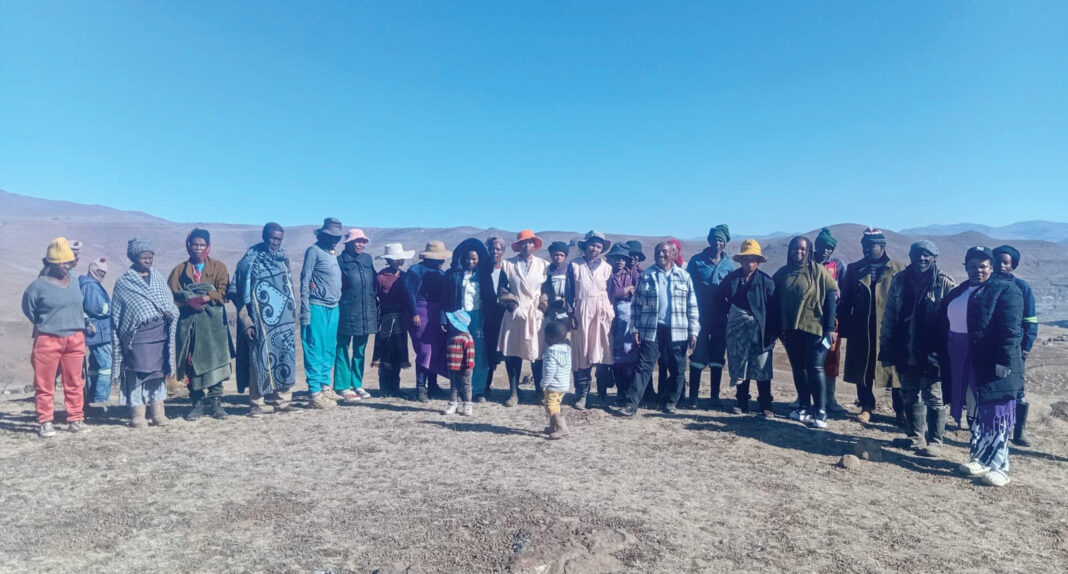
Approximately 300 workers employed at the Ramarothole Solar Power Plant Phase II project in Mafeteng are allegedly being paid below the minimum wage stipulated under Lesotho’s Labour Law 2024, raising concerns about workers’ rights and compliance with labour regulations.
The workers, employed in the construction of the solar power project by SINOMA TBEA Construction, reportedly receive M90 per day, against the M178 daily minimum wage said to be applicable to unskilled workers.
The claims have brought renewed attention to the protection of local workers employed by foreign companies operating in Lesotho, particularly in large-scale infrastructure and construction projects where employment opportunities are often welcomed by communities struggling with unemployment.
Speaking to theReporter this week, one of the workers said salary-related problems had persisted since the commencement of the project in August this year.
He explained that some workers had signed employment contracts while others had refused to do so because the documents did not clearly indicate their salaries.
“We are not given sufficient time to read the terms and conditions of the contracts. Some workers also do not understand what is contained in these documents,” he said.
The worker added that, because of the scarcity of employment opportunities, many people had accepted the conditions despite feeling that their labour rights were being violated.
He said workers had collectively attempted to engage the company’s human resources manager to address their concerns. However, they were allegedly told that the manager did not have time to attend to them and would only entertain two questions.
The workers’ concerns extend beyond remuneration to the transparency of employment arrangements and the treatment of employees at the construction site.
According to the worker, the project employs people on different arrangements, with some working for longer periods and others being engaged on short-term contracts. Some workers were also recruited from Phase I of the same project.
The unskilled workers reportedly undertake tasks such as operating and driving wheelbarrows and digging trenches, among other manual construction activities.
Another concern raised by workers relates to alleged age restrictions in recruitment. They claimed that people aged 40 and above were not being considered for employment, for unexplained reasons.
Councillor for Ha Ramarothole, Sebafi Moeketsi, confirmed that complaints about workers’ conditions had emerged following the commencement of Phase II.
Moeketsi said the concerns had started shortly after construction began, with many employees having worked for less than four months.
He said some workers did not have contracts clearly outlining the nature of their employment, their working conditions and the terms under which they were expected to perform their duties.
“Workers were verbally informed that they would be paid M90 per day. I have also heard complaints from some employees who told me that they were not being treated well,” Moeketsi noted.
He added that workers had reported discrepancies between the amounts they expected to receive and what was eventually paid.
“Some workers complained that they were supposed to receive M1,500 but were instead paid M1,200,” he stated.
Moeketsi explained that employees had joined the project at different times, with some starting during the week and others towards the end of the month. Consequently, their periods of employment varied.
Meanwhile, the Lesotho Electricity Generation Company(LEGCO), which is overseeing the project, said the organisation had already intervened after learning about the complaints.
LEGCO Public Relations Officer, Teboho Ratalane, told theReporter in an interview that their representatives visited the construction site on Tuesday this week for a scheduled engagement with the contractor.
He explained that the organisation normally holds routine monthly meetings with contractors to discuss progress on projects.
However, upon arriving at the site, the LEGCO officials learned about the workers’ grievances through discussions with some employees.
“When we arrived there, we heard about these concerns while engaging with some of the workers. After receiving the information, we decided that the matter needed to be addressed immediately while we were still at the site,” Ratalane said.
He noted that LEGCO immediately engaged the contractor and explained that the reported payment arrangements were unacceptable, emphasising that workers should be remunerated according to the applicable minimum-wage requirements.
Ratalane indicated that the discussions were constructive and that the contractor understood the concerns raised.
The issue of remuneration had since been addressed through an agreement that all workers employed at the site should sign employment contracts reflecting their respective job categories and the applicable minimum wages in Lesotho.
According to Ratalane, the contracts should clearly stipulate how much each employee is entitled to receive, depending on the category of work performed.
He expressed confidence that the matter would no longer be a problem following the engagement between LEGCO and the contractor.
A representative of SINOMA TBEA Construction, who requested anonymity, acknowledged that there had been organisational challenges during the initial stages of the project but said the company had not previously received formal complaints from workers about their salaries.
He explained that the company had initially been under pressure to accelerate construction, resulting in difficulties associated with mobilising resources and establishing operations.
“From the beginning, we were trying to comply with the law. Between August and September, there was a lot of chaos as we were preparing everything, mobilising resources, handling visas and work permits, and engaging subcontractors regarding the resources required for the project,” he said.
The representative said the allegations were the first time he had heard of workers raising concerns about their remuneration.
He added that employees had not approached the company’s management at the site to formally report the alleged underpayment.
Nevertheless, he assured this publication that the company would investigate the matter and take corrective action should any negligence or failure to comply with labour requirements be established.
“Since you (theReporter) has brought these complaints to our attention, we will investigate. If we discover that there was negligence on our part, we will verify the affected cases and compensate those who were not paid correctly,” he said.
The company would also pay closer attention to workers’ remuneration and employment conditions going forward.
Phase II of the project, with an installed capacity of 50 MW, commenced on-site construction in July 2026. It is expected to achieve an average annual power generation of 92 million kWh and a total projected power generation of up to 2.3 billion kWh over 25 years.
Building on the success of Phase I (30 MW), the 50 MW Phase II represents a strategic expansion featuring upgraded technology and grid regulation capabilities, including a newly added 8 MWh Battery Energy Storage System (BESS) integrated into Ramarothole Substation.
With an expected average annual generation of 92 million kWh and 2.3 billion kWh over its lifecycle, Phase II will further narrow Lesotho’s power deficit, reduce costly electricity imports from South Africa, and stabilise domestic tariffs.
During construction and the contractor’s five-year O&M service period, the project is expected to create substantial local employment, drive procurement and subcontracting multiplier effects, transfer advanced solar-plus-storage engineering and maintenance skills, and build a sovereign local technical team, laying the foundation for Lesotho’s long-term green energy self-sufficiency and its strategic transition into a power exporter.