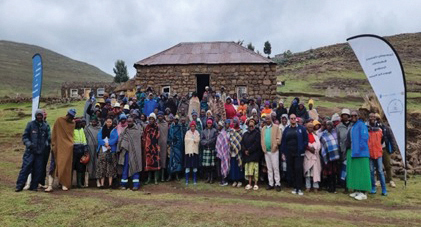

Lesotho continues to grapple with recurring violence, community conflicts and cycles of revenge that threaten social cohesion and undermine development, prompting renewed efforts to strengthen community-led approaches to peacebuilding and conflict prevention.
Rising insecurity, including homicides, robberies and communal violence has raised concerns about the safety of communities and factors contributing to persistent crime.
According to data cited by the United Nations Development Programme (UNDP) Lesotho, 759 homicides were recorded between January and October 2022, placing the country among those with high homicide rates globally.
Against this backdrop, the Lesotho Council of Non-Governmental Organisations (LCN), with support from UNDP Lesotho and UN Women and funding from the United Nations Secretary-General’s Peacebuilding Fund, is implementing the ‘Supporting Community-driven Violence Reduction and Sustainable Peace in Lesotho’ project.
The initiative seeks to strengthen community-led conflict prevention and resolution, promote human rights awareness, and ensure that women and young people play a meaningful role in peacebuilding.
Mantŝalla Ramakhula, Coordinator of the Gender, Youth and Children’s Commission from LCN, told the Reporter that the initiative began its community engagement with a gateway meeting involving local leaders in the three districts where the project is implemented – Maseru, Mafeteng and Mokhotlong – in September 2025.
She said the meeting introduced the project, fostered collaboration and secured community buy-in, while identifying local priorities, opportunities and challenges in advancing peace and development.
As part of its efforts to strengthen community participation, LCN, with support from UNDP and UN Women, held a three-day training for Local leaders in their respective Districts, bringing together area chiefs, traditional community leaders, women and young people as key stakeholders in community peace and security.
Ramakhula noted that the training strengthened participants’ capacity in peacebuilding, inclusive leadership, decision making, mediation and violence prevention.
It also enhanced their understanding of District Action Plans (DAPs) and the United Nations Security Council resolutions on Women, Peace and Security (1325) and Youth, Peace and Security (2250).
Resolution 1325 recognises the importance of women’s participation in conflict prevention and peacebuilding, while Resolution 2250 calls for meaningful involvement of young people in peace and security processes.
Participants engaged in dialogue and civic education on these frameworks, with the aim of translating their principles into community-level action.
The engagement was intended to increase awareness, strengthen motivation and encourage local commitments to peace, inclusion and social cohesion.
“Beyond the training, the project hosted public gatherings in Mafeteng, Mokhotlong and Maseru, including Kolo Ha Petlane [MR1] in Mafeteng, Khubelu, Menoaneng and Libibing in Mokhotlong, and, Ha Mantsebo (Qeme), Rothe, Ha Tsolo and Ha Abia in Maseru,” Ramakhula explained.
The gatherings provided platforms for introducing the initiative, encouraging collaboration and discussing the priorities and challenges facing communities in their efforts to prevent violence.
The meetings also highlighted the importance of including women in leadership and decision making processes (peacebuilding), with the proposed establishment of peace clubs led by women presented as a community-driven approach to mediating disputes, promoting dialogue and preventing conflicts from escalating.
In Ha Tsolo, Maseru District, traditional leaders and other stakeholders have been working to address a history of violence that has affected the community for years.
Chief Mootisa Mootisa said stakeholders had initiated several activities and projects in the village, including plans to establish animal pens and pig-rearing aimed at empowering young people.
He told this publication that a peacebuilding committee had also been established to investigate the causes of violence and help resolve disputes among residents.
“We tried to find out where these violent activities originated and learned that there were people who were killing one another, although they were not originally from Ha Tsolo. They came from other surrounding areas, chased one another into Ha Tsolo, and ended up killing each other here,” he added.
Mootisa stated that discussions with residents had also brought attention to the economic challenges facing the community, particularly the decline in factory employment.
Ha Tsolo grew as people moved to the area in search of factory jobs. However, as employment opportunities declined, some residents found themselves struggling to make a living.
“We also discussed the causes of crime. Ha Tsolo grew because of the factories, but most of the factory jobs have disappeared. For some people, returning home has become a challenge because they had come to the area specifically to work in the factories and do not know what else to do now that those jobs are gone,” Chief Mootisa pointed out.
He indicated that the peace building committee was tasked with bringing together people involved in disputes and helping them resolve their differences before conflicts escalated.
Committee members were attending workshops and receiving training to strengthen their ability to manage disputes.
“The committee was established to explore how it could help bring disputes under control wherever they arose,” Chief Mootisa revealed.
According to him, violence had persisted for many years despite the involvement of the police and the army, making it difficult for residents to understand and address the problem.
“At one point, Ha Tsolo’s crime rate was among the highest compared with other villages in the country,” he recalled.
In Khubelu, Mokhotlong District, Chief Morakabei Sekonyela said several government departments and other stakeholders had become involved in efforts to address the area’s rising crime.
However, he noted that some of the issues raised during the engagements were already being discussed by chiefs during their public gatherings.
Sekonyela said community members understood that addressing crime and violence required long-term solutions and could not be the responsibility of traditional leaders alone.
“They came together with chiefs and the Community Policing Forum after their training highlighted that Khubelu was among the areas where crime was increasing daily, particularly cases of people killing one another.”
However, the chief expressed uncertainty about the progress made since the training sessions, adding that since the sessions were held, they had not heard anything further.
[MR1]This is one place. The village is called Ha Petlane which is found in KOLO (Mafeteng District)