
The Public Accounts Committee (PAC) has called for a forensic audit into the Central Bank of Lesotho’s activities to trace M3.9 billion missing from government cash balances, warning the amount is too large to ignore.
The Auditor General’s report showed government held M5.91 billion in cash as at 31st March 2024. However, the Consolidated Financial Statements (CFS) reflected only M2.82 billion, creating a discrepancy of M3.9 billion.
The AG’s report also shows the consolidated statements of cash receipts and payments revealed that the government had a cash balance of M5.71 billion as at 31st March 2023, whereas Note 15 showed a total cash balance of M2.22 billion, thus resulting in a discrepancy of M3.49 billion between the two balances.
PAC says only a transaction-level forensic investigation can establish the flow and legitimacy of the payments, after years of adverse audit opinions on government accounts.
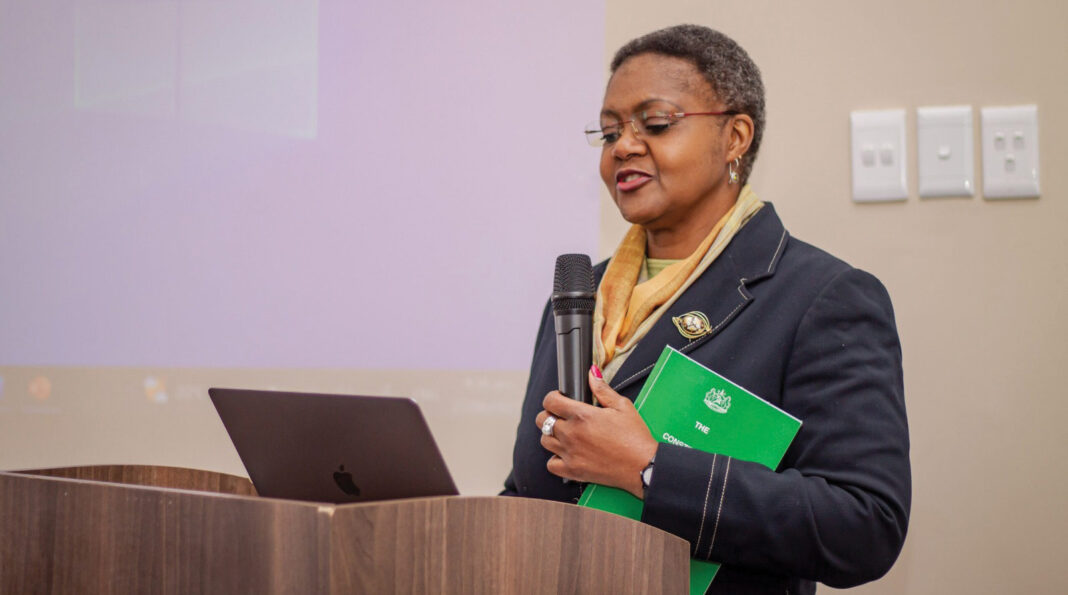
PAC chairperson, ‘Machabana Lemphane-Letsie made the demand on Monday this week during a hearing where the Auditor General presented the consolidated financial statements for 31st March 2023 and 2024.
Lemphane-Letsie expressed concern over the untraced funds saying the money could have made a significant contribution to the development of the country.
“In a country such as ours where most people are vulnerable, M3.09 billion is not an amount of money that can be ignored and say we start on a clean slate,” she said, citing the problem has persisted since 2021, when audit reports showed a M6.1 billion gap.
She added: “If the funds remain unaccounted for, it means the Central Bank of Lesotho is not audited. The office of the Auditor General has failed to trace the funds, DCEO (Directorate for Economic Offenses) will also likely not to find the money. CBL must undergo a forensic audit and say who the money has been paid to.
Auditor General, ‘Mathabo Makenete, told PAC the discrepancy grew because the Accountant General’s office failed to conduct monthly reconciliations.
Without reconciliations when payments were made, errors accumulated instead of being resolved. I recommended that the Accountant General should conclude reconciliation exercise, Makenete noted.
She also indicated that while financial regulations require that no payment leaves a government account without authorisation from signatories appointed by the Accountant General, the rule was bypassed in several cases.
“Some transactions seem to have been processed outside the Financial Management Information System (IFMIS). In some instances, when the system jammed, payments were re-entered and duplicated. For external debt payments around 2020 and earlier, funds moved directly from the Public Debt Office to CBL without the Accountant General’s authorisation or IFMIS processing.
“CBL also returned payments where instructions did not match payee details. Many were never corrected. Without monthly reconciliations, those errors went undetected,” Makenete pointed out.
The Deputy Auditor General, Chaile Nkopa, told the committee the office does not dispute that fraud or foul play may have occurred in the M3.9 billion gap.
However, the AG’s audit cannot yet establish where the money went because it is still waiting for transaction-by-transaction reconciliations from the Accountant General, Nkoka said.
The hearing exposed a dispute over who should audit CBL. The bank cited its 2000 Act, which provides for an external auditor and limits the Auditor General to auditing currency balances, not government payments made on behalf of the state. On the other hand, the PFMA Act mandates the AG’s office to audit it, the central bank argued.
“CBL can’t audit itself on government funds. It is 100 percent owned by government,” Lemphane-Letsie stated.
PAC member, Thabiso Lekitla, accused the Auditor General’s office of hiding behind the CBL Act, arguing that audit law and the PFMA clearly require the AG to audit the bank.
Makenete said CBL executes payments only under instructions from the Treasury through IFMIS or the Public Debt Office, and no bank is permitted to authorise payments without required signatories.
IFMIS is an automated, computerised system used by the government to manage public sector budgetary, financial and accounting operations.
The AG’s office added there is currently no expertise or budget allocated for a forensic audit.
The office’s report also showed that in the Consolidated Financial Statements (CFS) as at 31st March 2024, there were 317 government accounts, comprising 280 held at CBL and local commercial banks. Thirty-seven accounts were opened with local mobile network operators, with a total balance of M2.82.
Makenete further indicated that CFS shows a cash increase of M600 million from M2.22 billion to M2.82 billion between 31st March 2023 and 31st March 2024, while the Consolidated Statements of Cash Receipts and payments indicates a cash increase of M1.31 billion, resulting in a discrepancy of M710 million.
“As indicated in my previous audit reports, these discrepancies continue to compromise the integrity of the CFS,” she said.
Makenete has also recommended that the Accountant-General should review all government official bank accounts monthly and annually, closing any dormant accounts to prevent misuse.
Section 74 of the Treasury Regulations, 2014 authorises the Accountant-General to establish and maintain agreements with the CBL to define and operate the structure of the consolidated Fund bank account, including sub-accounts.
The Accountant-General also has the power to set up and manage agreements with commercial banks for the operation of other bank accounts.
PAC resolved that the Auditor General’s office must submit a proposal for the required forensic audit budget by 30 June so it can be included in the supplementary budget.
The Public Financial Management and Accountability Act 2011 (PFMA Act, 2011) mandates that the Consolidated Financial Statements (CFS) shall be prepared per the International Public Sector Accounting Standards financial reporting under cash basis and be submitted to the Auditor-General for audit within five months of the end of the financial year.