
. . . warn against rising xenophobia
. . . call for dignified migration policies
. . . as June 30 deadline approaches
Migrant rights organisations in Lesotho are urging the governments of Lesotho and South Africa to adopt a more humane and practical approach to migration management following recent remarks by South African President Cyril Ramaphosa on illegal immigration.
The Migrant Workers Association (MWA) and Hands Off Basotho have called for stronger protections for Basotho migrants and the creation of easier legal pathways for employment and residency in South Africa.
They argue that migration policies should prioritise dignity, safety and regional cooperation rather than punitive measures.
The groups warn that growing anti-immigrant sentiment and stricter enforcement measures could leave Basotho workers increasingly vulnerable to discrimination, exploitation and insecurity.
Their concerns follow threats by South African anti-illegal immigration movement, March and March, which reportedly gave foreign nationals until June 30 to leave the country or face violent consequences. The movement accuses undocumented migrants of taking jobs and placing pressure on public services and resources.
In response to the threats, several African countries, including Ghana and Malawi, have mobilised resources and offered transport to assist their citizens who wish to return home.
According to a report by Integral Human Development, Lesotho recorded a brain drain index of 7.5 out of 10 in 2021, significantly higher than the global average of 5.25 among 173 countries.
The report further indicates that Lesotho’s emigration stock stood at 16.07 percent in 2019, representing 341,580 Basotho living abroad.
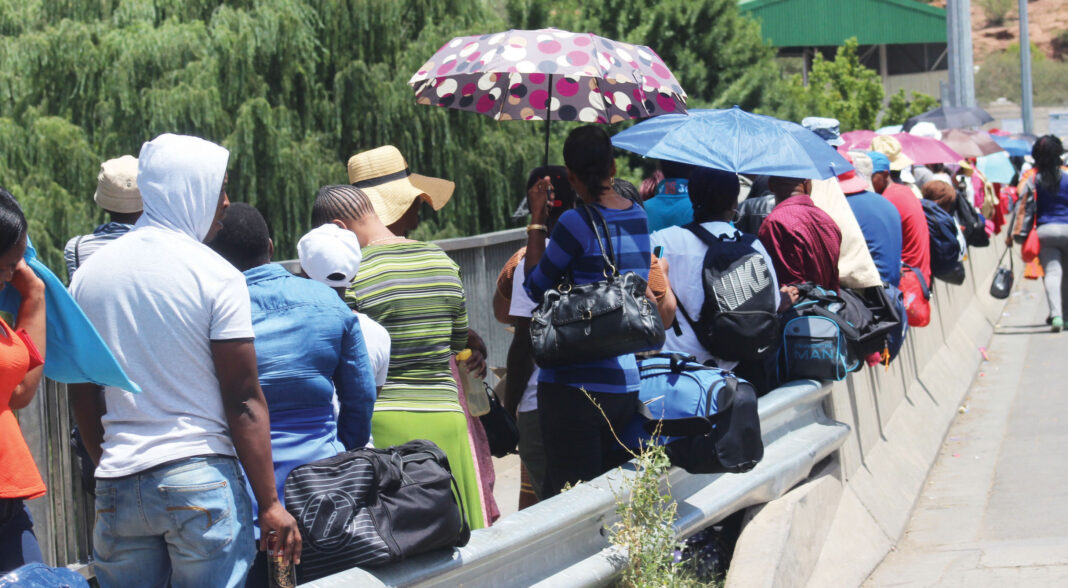
South Africa remains the primary destination for Basotho migrants, hosting an estimated 331,312 people. Smaller migrant populations are found in Mozambique, the United Kingdom, Botswana and Eswatini.
Employment opportunities continue to be the main driver of migration, with many Basotho working in factories in KwaZulu-Natal and in the mining industry in Gauteng.
MWA Executive Director, Lerato Nkhetše, expressed concern over President Ramaphosa’s use of the term “illegal migrants”, arguing that “irregular migration” is a more appropriate description.
“Language matters. Illegal labels the person, while ‘irregular’ describes a migration status that can be changed through policy,” Nkhetše said.
He argued that Ramaphosa’s address offered little hope for meaningful solutions and instead reinforced narratives that have fuelled hostility towards foreign nationals.
“Instead of opening space for solutions, it seems to reinforce narratives that other groups have already started. That approach deepens stigma instead of addressing root causes,” he noted.
Nkhetše stated that foreign nationals in South Africa continue to face xenophobic violence, discrimination and fear. He called on governments across the region, including Lesotho’s, to pursue active diplomacy aimed at creating regular migration pathways, modern migration agreements and stronger protection mechanisms.
“A modern migration dispensation is overdue—one that protects both Basotho abroad and foreign nationals living here while supporting orderly, safe and dignified movement,” he added.
Speaking on Sunday, Ramaphosa condemned campaigns that spread misinformation and division as South Africa intensifies efforts to tackle illegal immigration and strengthen migration management.
He acknowledged public concerns about migration, pressure on public services, jobs, safety and the rule of law, saying such concerns were legitimate and deserved attention.
“We know that South Africans are not xenophobic,” Ramaphosa said, adding that there is no place for xenophobia, racism, sexism, Afrophobia or any other form of intolerance in the country.
He warned, however, that some groups were exploiting concerns about illegal immigration to incite violence and lawlessness, while others were spreading falsehoods through social media campaigns.
“We will not be fooled or influenced by social media campaigns that spread misinformation, fake news and lies about foreign nationals,” he said.
Ramaphosa stressed that immigration-related concerns must be addressed within the framework of the Constitution, the law and international obligations.
“No other person is allowed, for example, to confront someone in the street to demand proof of nationality,” he stressed.
The South African president also reaffirmed his government’s commitment to protecting the rights of all people within the country’s borders, regardless of nationality
Despite those assurances, Nkhetše said many Basotho migrants remain fearful.
“Even though Ramaphosa said groups such as Operation Dudula and March and March should not search people, it does not necessarily mean it will not happen. It will happen, but it will be done by people with the authority to do it. Basotho migrants remain afraid,” he pointed out.
He argued that increased emphasis on border security, deportations and workplace inspections where undocumented migrants are employed has heightened anxiety among migrant communities.
In a letter addressed to the South African Human Rights Commission on May 27, Nkhetše requested an investigation into alleged human rights violations against foreign nationals.
He asked the commission to engage relevant stakeholders and authorities to stop unlawful actions that threaten migrants’ rights and safety.
“As a stakeholder focused on the rights of migrant workers, I have documented numerous incidents indicating serious contraventions of Sections 9, 10, 12 and 22 of the South African Constitution,” he wrote.
The cited provisions protect rights relating to equality, human dignity, freedom and security of the person, as well as freedom of movement and residence.
Hands Off Basotho leader, Semenyane Linale, welcomed the opportunity to comment on South Africa’s proposed immigration reforms, describing the current debate as a chance to establish a progressive framework reflecting the unique relationship between Lesotho and South Africa.
Linale said migration policies affecting Basotho should not be treated in the same way as those applied to people from distant countries, since Lesotho is enclaved by South Africa.
“Our borders are artificial separations of a single people with a shared history, culture and economic destiny. Progressive governance requires that our geographical oneness is translated into a seamless, hassle-free policy of integration,” he advised.
Linale called on South Africa to establish a simplified system under which a national identity card or passport would be sufficient for Basotho to enter, reside and work legally in the country.
“We call for the complete removal of bureaucratic bottlenecks associated with securing formal work permits for Basotho,” he pleaded.
According to Linale, allowing Basotho to work legally using primary identity documents would help regularise the existing labour force, increase tax revenues and reduce workers’ vulnerability to exploitation.
He further urged policymakers to approach migration as a development and partnership issue rather than a security problem.
“History proves that heavy-handed enforcement and strict permit requirements do not stop human migration; they only drive honest workers into the shadows, making them easy targets for unfair dismissal and workplace intimidation,” he said.
Linale argued that a simplified migration framework would create a more organised, secure and legally accountable workforce while strengthening relations between the two neighbouring countries.